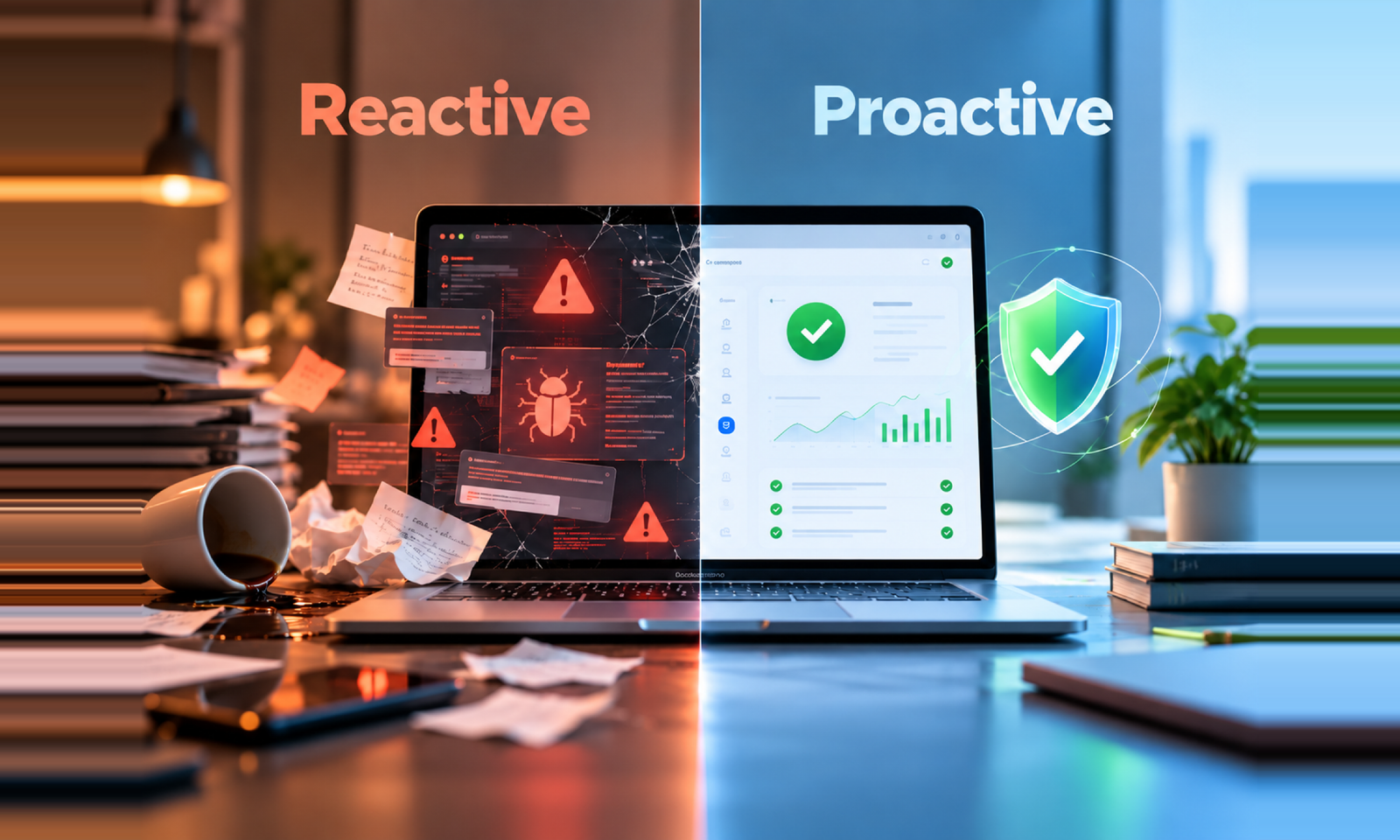
Reactive app maintenance looks cheaper on a budget because you spend little until something actually goes wrong.
Proactive maintenance does the opposite. Engineering time is deliberately spent on monitoring, updates, testing, capacity, recurring defects and emerging technical risks before they create an incident.
Viewed month by month, the reactive model can appear more economical. Viewed across the life of an important application, the calculation changes because the real cost of a failure is rarely limited to the time required to fix the code.
For applications where failures have meaningful business consequences, proactive maintenance will generally reduce total maintenance cost over time. Reactive maintenance can still be the cheaper choice when the application is low-risk, rarely changes and the cost of failure is genuinely small.
The right comparison is therefore not “maintenance now versus maintenance later.” It is “the cost of preventing a problem versus the full cost of allowing it to happen.”
Reactive maintenance
Proactive maintenance
When work happens
After a problem becomes visible
Before known risks become failures
Upfront engineering cost
Lower
Higher
Work predictability
Lower; failures set the schedule
Higher; much of the work can be planned
Incident exposure
Higher if weaknesses remain undiscovered
Reduced where risks can be identified early
Typical hidden costs
Downtime, emergency work, repeated incidents, support load
Monitoring, testing, reviews, upgrades and preventive fixes
Best fit
Low-impact systems where failure is tolerable
Important applications where failure or recovery is expensive
There is no credible rule saying proactive work is always cheaper. Research on preventive maintenance in operational software explicitly recognises that prevention has its own cost and that it needs to be weighed against the expected cost of failures.
That trade-off is the important part.
[Internal Link: “Preventive App Maintenance: How to Fix Problems Before Users Find Them”]
The appeal is easy to understand.
If an application is running normally, a reactive approach asks why the business should pay engineers to investigate potential problems that may never happen. Instead of reviewing a component because it might cause trouble, the team waits until there is evidence that it actually has.
For some software, this is rational.
Imagine a small internal application used occasionally by a handful of employees. If it becomes unavailable for an hour, the team can use a manual workaround and nobody loses revenue or important data. Spending substantial engineering effort building advanced monitoring, redundancy and preventive processes for that application may cost more than occasionally repairing it.
This is the strongest case for reactive maintenance: the consequence of failure is lower than the cost of preventing it.
Problems begin when businesses apply the same logic to applications where the failure has a much larger blast radius.
An ecommerce checkout, customer-facing SaaS application or system supporting critical internal operations creates costs beyond the developer time required to fix a bug. Lost transactions, employee interruption, customer support, investigation, recovery and reputational effects can all enter the equation.
At that point, “we only pay when something breaks” is no longer an accurate description of the cost model.
Suppose a memory problem eventually causes an application outage.
The engineering fix takes three hours.
It would be tempting to call those three hours the cost of the incident, but that leaves out most of what happened around the fix. Someone had to detect the problem, diagnose it, coordinate the response, communicate with affected teams or customers, restore service and then understand whether the issue could happen again.
Google's SRE incident-management guidance notes that recurring outages increase operational toil and can affect error budgets, user trust and revenue. Its recommendation is not simply to restore service, but to learn from incidents so the same failures do not continue resurfacing.
The economic difference matters because reactive maintenance tends to concentrate engineering effort at the moment when there is the least flexibility.
An update that could have been scheduled for Tuesday morning becomes an emergency change on Friday evening. A database approaching capacity could have been expanded during planned work, but once it reaches its limit the priority becomes restoring production as quickly as possible.
The technical task may be similar in both cases. The conditions under which engineers have to perform it are not.
Proactive maintenance shifts some of that effort earlier.
Instead of waiting for storage to run out, teams monitor its rate of growth. An ageing dependency is reviewed before it becomes several major versions behind. A recurring error is investigated before it develops into a wider failure. Tests are added around a risky workflow before another release changes it.
All of this costs engineering time.
The benefit is that the work can often be handled when the team still has choices.
A planned dependency update can be assessed, tested and released through the normal deployment process. An emergency migration caused by an unsupported component has far less room for careful sequencing.
This does not mean proactive teams eliminate incidents. Complex software will fail.
The advantage is reducing avoidable incidents and making the remaining ones cheaper to detect and recover from.
Google's DORA research uses change failure rate and time to restore service as two of its core measures of software-delivery stability. Those metrics are useful for this cost discussion because they capture both how frequently changes create production trouble and how long the organisation remains exposed when failure occurs.
There is another cost that rarely appears in the first maintenance budget: work becoming progressively harder.
If preventive work is repeatedly postponed, applications can accumulate technical debt that increases the cost of future changes.
Research from Carnegie Mellon University's Software Engineering Institute describes technical debt as a short-term decision that creates greater complexity and cost later, and notes that unmanaged debt increases development and sustainment costs.
Empirical software research has found the same relationship at code level. A study of ten open-source PHP applications found that modules carrying greater technical debt required more corrective maintenance and were more defect-prone.
This is where an exclusively reactive model can become expensive without producing one dramatic invoice.
A framework upgrade is postponed because nothing is broken. Later, moving to the supported version requires crossing several major releases. A fragile module is left alone because users cannot see the problem, but every subsequent change takes longer because engineers are afraid of creating regressions.
The cost appears gradually in estimates, release delays and corrective work.
[Internal Link: “How Technical Debt Affects the Health of Your Application”]
A useful decision is to compare prevention cost with expected failure cost, rather than treating proactive maintenance as automatically worthwhile.
Consider four questions.
A dependency reaching end-of-support next month presents stronger evidence than an engineer's vague concern that some code might become difficult someday.
Proactive work should be evidence-driven.
Include more than the engineering fix. Consider downtime, lost transactions, staff interruption, support effort, recovery, data risk and customer impact where relevant.
Some issues are inexpensive to defer. Others compound. Skipping one routine upgrade can turn the eventual change into a multi-version migration; delaying a capacity increase can convert planned infrastructure work into incident response.
Prevention does not always require a large project. A targeted alert, regression test, dependency patch or small refactor may remove most of the risk for comparatively little effort.
The strongest candidates for proactive maintenance are therefore high-consequence risks with credible warning signs and relatively inexpensive preventive actions.
Not every application needs an extensive proactive maintenance programme.
Reactive maintenance can be economically reasonable where the application has low business importance, failures are easy to recover from, data is not at significant risk and downtime causes little disruption.
It can also make sense for a component approaching retirement. Spending heavily to modernise software scheduled to be replaced in three months may provide little return unless the current risk is significant.
The mistake is applying a reactive strategy by default rather than deliberately.
“We will repair this if it fails because failure is inexpensive” is a defensible decision.
“We have no idea what will fail, but we'll deal with it when it happens” is not really a maintenance strategy.
Purely proactive maintenance is unrealistic because unexpected defects and incidents will always exist. Purely reactive maintenance leaves teams exposed to problems they could reasonably have seen coming.
Most healthy maintenance programmes therefore use both.
Reactive work handles unexpected production issues, while proactive work focuses on risks where early intervention has a clear economic or operational advantage.
For Levelworks, the App Health perspective helps identify where those proactive investments belong. Weak Observability can make failures expensive to discover, outdated components affect Secure and Current & Updated, recurring defects weaken Error Free, while fragile releases point toward problems with Tested or Seamlessly Updatable.
The aim is not to spend equal effort across every App Health Aspect. It is to recognise which weaknesses have the greatest potential to create expensive reactive work later.
[Internal Link: “The App Health Checklist: How Healthy Is Your Application?”]
Reactive maintenance usually wins on immediate spend because it postpones engineering work until there is a demonstrated problem.
That does not necessarily make it cheaper.
For applications where an outage, security weakness or failed release carries meaningful consequences, the cost equation needs to include emergency engineering, recovery time, lost productivity, user impact and the increasing cost of deferred technical work.
Proactive maintenance spends earlier in exchange for reducing some of that uncertainty.
The most economical approach is therefore not to prevent everything, nor to wait for everything to break. It is to spend preventive effort where the expected cost of failure justifies it and accept reactive handling where it genuinely does not.
That is the difference between simply cutting maintenance spend and actually controlling the cost of keeping an application healthy.