A development team can spend months securing the code it writes and still inherit a serious vulnerability from code it never touched.
Imagine an application that directly depends on a popular framework. That framework relies on several other packages, which in turn depend on additional libraries deeper in the dependency tree. One of those transitive packages contains a newly disclosed vulnerability.
Your developers did not select that package directly. They may not even recognise its name.
It can still become part of your security problem.
This is one reason dependency security becomes harder as applications mature. Frameworks, packages, SDKs and runtimes that were reasonable choices when the application launched do not remain frozen in time. New vulnerabilities are discovered, maintainers stop supporting older releases, and the distance between your installed version and the maintained version grows.
The application can continue working throughout that process.
Outdated dependencies create security risk not simply because they are old, but because ageing software is more likely to leave known vulnerabilities unresolved, lose vendor or community support, hide vulnerable transitive components and become increasingly difficult to update when a security fix is finally urgent.
That distinction matters. An old package is not automatically insecure. The risk comes from allowing dependency age to become dependency neglect.
Dependency risk begins with understanding what a dependency actually is.
Suppose your application declares package A.
Package A requires package B. Package B requires packages C and D. Those packages may bring in additional components of their own.
Your application now relies on all of them, even though only package A appears in the decision your development team originally made.
These are transitive dependencies.
GitHub describes an application's dependency graph as including packages it depends on both directly and indirectly. Its security tooling can identify vulnerable transitive dependencies where the relevant version information is available through manifests or lock files. GitHub: Vulnerable Dependency Detection
OWASP makes the same point in its current Top 10:2025 Software Supply Chain Failures guidance: organisations need to track not only components they selected directly, but also nested or transitive dependencies.
This creates the first major security problem with outdated dependency management:
You cannot assess the security of software you do not know you are running.
A project can have ten dependencies listed prominently in its manifest while its resolved dependency tree contains many more components.
There is an important nuance here.
A package being two versions behind does not automatically make it dangerous.
The installed version may contain no known vulnerability relevant to your use case. A newer release may contain only features or fixes your application does not need.
Security teams therefore should not treat:
old = compromised
as a useful rule.
The stronger concern is whether the dependency is:
OWASP's current guidance specifically treats vulnerable, unsupported and out-of-date software as related risk conditions rather than assuming version age alone determines security.
This is why dependency maintenance should be risk-based rather than a race to install every release.
The goal is not permanent version perfection.
It is to prevent normal version drift from becoming a security constraint.
One of the clearest risks comes when a dependency contains a publicly disclosed vulnerability.
Once the affected versions and corrected version are known, attackers and defenders have access to much of the same information.
If the vulnerable version remains deployed, your application may continue carrying the weakness even though a correction already exists.
OWASP Dependency-Check was designed around exactly this problem. It identifies project dependencies and checks them against known, publicly disclosed vulnerabilities so teams can discover vulnerable components embedded in their applications. OWASP Dependency-Check
The maintenance problem is not necessarily that teams refuse to fix vulnerabilities.
Often, they do not know the vulnerable package is present, or they know about the dependency but have lost track of which version actually reached production.
That makes accurate dependency inventory part of security work.
CISA's guidance on Software Bills of Materials describes an SBOM as a nested inventory of software components and highlights its use in vulnerability management and identifying component dependencies and supply-chain risks. CISA: SBOM Resources
Without that visibility, vulnerability response starts with discovery rather than remediation.
A dependency does not need a currently known vulnerability to create security concern.
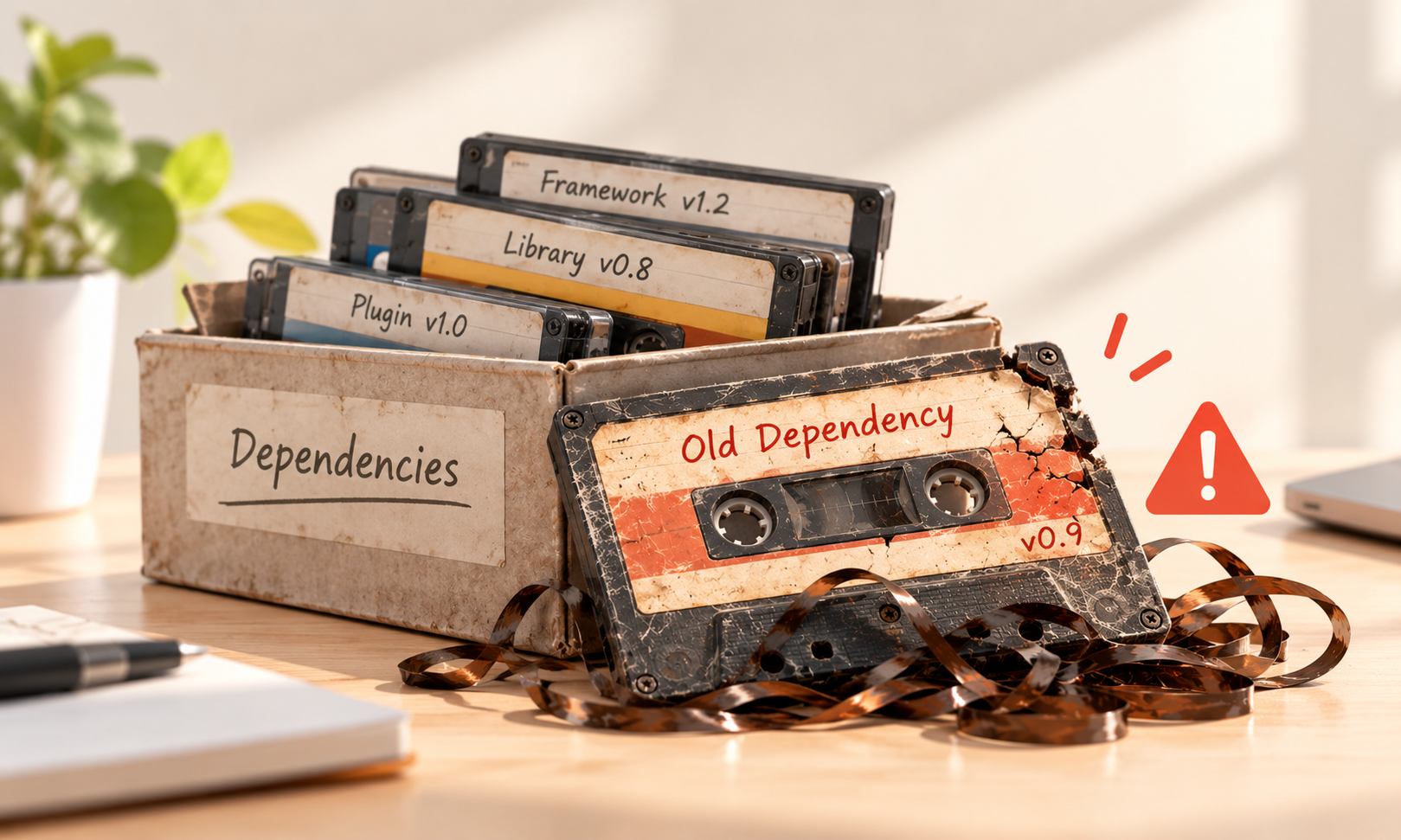
The maintainers may simply have stopped supporting the version.
That changes what happens when the next vulnerability appears.
A maintained release can receive a patch.
An unsupported release may never receive one.
The team may then have to move to a much newer version, replace the package altogether or create temporary mitigations while a migration is prepared.
OWASP specifically recommends monitoring for components that are unmaintained or whose older versions no longer receive security fixes. Where patching is impossible, its guidance suggests considering migration to an alternative or other protective measures.
This is why support status matters even before an exploit exists.
The security weakness is partly loss of response options.
A maintained dependency gives the organisation somewhere to go when a problem is found.
An abandoned dependency leaves the application increasingly responsible for solving upstream problems itself.
For Levelworks, this is where Secure and Current & Updated begin to overlap. A dependency may not be actively vulnerable today, yet allowing it to fall outside supported versions can weaken the application's ability to remain Secure tomorrow.
Direct dependencies are relatively easy to reason about because developers chose them deliberately.
Transitive dependencies are harder.
Suppose:
Your application
↓
Framework A
↓
Library B
↓
Utility C
A vulnerability is discovered in Utility C.
Your application does not reference Utility C directly. Updating it may not be possible by changing its version alone because Framework A or Library B restricts which versions can be installed.
GitHub documents this exact dependency-resolution problem: a vulnerable transitive package may require an update to its parent dependency before the dependency graph can resolve to a secure version. In deeper ecosystems, fixing one vulnerable component can therefore require updating several related packages. GitHub: Troubleshooting Dependabot Errors
This explains why dependency age matters even when today's version contains no urgent vulnerability.
The further the dependency tree drifts from maintained versions, the harder tomorrow's security correction may become.
Consider two applications using the same library.
Application A updates reasonably regularly and is currently on version 8.4.
Application B has not updated in several years and remains on version 4.9.
A vulnerability is announced and fixed in version 8.5.
For Application A, remediation may be a relatively small change.
For Application B, version 8.5 may require:
The vulnerability is the same.
The cost and risk of fixing it are not.
GitHub explicitly recommends staying reasonably current because doing so increases the likelihood that a vulnerable dependency can be corrected through a manageable update rather than a large dependency-graph change.
This is the security consequence of dependency debt.
Teams sometimes postpone updates to avoid introducing change risk. Over time, that strategy can create a much larger change precisely when a security vulnerability makes delay least comfortable.
[Internal Link: “Why Dependency Updates Are Essential to App Maintenance”]
Dependencies rarely age independently.
A library may require an older framework. That framework requires an older runtime. The runtime is supported only on an older operating-system environment.
One deferred upgrade creates another.
Eventually the application develops a chain of technical constraints:
Old library
↓
Requires old framework
↓
Requires old runtime
↓
Limits available security upgrades
At that point, the security problem is no longer simply “update the vulnerable package.”
The application has become structurally difficult to bring onto a supported path.
This is why dependency maintenance affects more than the Secure dimension of App Health. It also influences Current & Updated, Compatible, Tested and Seamlessly Updatable.
If an application's technology cannot be upgraded without destabilising the product, security work becomes increasingly expensive.
[Internal Link: “What Happens When Your App Uses an Outdated Framework?”]
Dependency scanners can produce large numbers of findings.
Treating every result as equally urgent creates a different problem: teams spend their time processing vulnerability volume instead of understanding risk.
A package may contain vulnerable functionality your application never invokes. Another vulnerable component may sit behind several controls and be unreachable from an attacker.
That does not mean the finding should be ignored.
It means the next question should be about exposure.
Useful triage questions include:
Question
Why it matters
Is this version actually deployed?
Repository findings do not always represent production.
Is the affected functionality used?
Vulnerability presence and exploitability are not always identical.
Can an attacker reach it?
Exposure changes practical risk.
What privileges does the component have?
Exploitation impact may depend on what the application can access.
Is exploitation occurring in the wild?
Active exploitation can change remediation urgency dramatically.
Is a secure version available?
Determines the remediation path.
CISA's Known Exploited Vulnerabilities Catalog provides one useful prioritization input because it identifies vulnerabilities for which there is evidence of exploitation in the wild.
The objective is therefore not to create a vulnerability backlog ordered entirely by headline severity.
It is to determine which vulnerable dependencies create meaningful exposure in your application.
An old package that no longer provides useful functionality still has to be tracked.
Its vulnerabilities still create alerts.
Its transitive dependencies still expand the dependency tree, and somebody eventually has to determine whether a security advisory affecting it matters.
OWASP recommends removing unused dependencies, unnecessary components and unneeded functionality as part of reducing software supply-chain attack surface.
This is an underrated form of dependency maintenance.
If a package no longer provides meaningful value, the safest version may be no version at all.
Reducing the dependency surface makes future security analysis easier because there are fewer components whose behaviour, maintenance status and vulnerability history need to be understood.
Tools such as OWASP Dependency-Check and GitHub Dependabot can identify known vulnerable components and automate parts of the upgrade process. GitHub's Dependabot can alert teams when vulnerable dependencies appear and create pull requests that move qualifying dependencies toward secure versions. GitHub: Dependabot Quickstart
These tools solve an important problem:
awareness.
They do not answer every maintenance question automatically.
A team still needs to decide:
This is where dependency security stops being a scanner configuration problem and becomes part of application maintenance.
There is a tempting but dangerous conclusion from dependency-security advice:
newer must always be safer.
Updates themselves can contain defects. Breaking changes may alter application behaviour, and supply-chain attacks can involve malicious changes introduced through otherwise trusted software channels.
OWASP's 2025 supply-chain guidance therefore recommends testing the compatibility of updated or patched libraries and avoiding indiscriminate deployment of updates to all systems simultaneously.
Security maintenance needs both sides of the equation:
do not leave vulnerable software unchanged indefinitely, but do not ship dependency updates blindly either.
A practical update path should include:
This is where Tested and Seamlessly Updatable become security capabilities, even though neither is primarily a security control.
If updating dependencies is consistently frightening, the application has a broader health problem.
[Internal Link: “Why Security Patching Should Be Part of Every App Maintenance Plan”]
A dependency strategy focused only on currently vulnerable packages is still reactive.
Useful warning signs include:
These do not all represent immediate vulnerabilities.
They indicate security maintenance friction.
That matters because an urgent vulnerability rarely gives teams the ideal moment to untangle several years of dependency debt.
NIST's Secure Software Development Framework recommends integrating secure-development practices throughout the software lifecycle so organisations can reduce vulnerabilities in released software, mitigate those that remain and address root causes rather than repeatedly treating symptoms.
For dependency security, that starts with visibility.
Maintain an accurate picture of important direct and transitive dependencies, monitor them for relevant vulnerabilities and support changes, and make dependency maintenance part of normal engineering work rather than an occasional cleanup project.
The goal is not to update everything continuously for its own sake.
It is to avoid reaching the point where a known vulnerability appears and the team discovers that the secure version is several architectural decisions away.
Outdated dependencies become dangerous when they reduce the application's ability to respond.
That is the key App Health connection.
A healthy application does not need every package to be on the newest release. It needs its dependency stack to remain sufficiently understood, supported and changeable that when security conditions change, the team can respond without turning an ordinary update into an emergency modernization project.