Some of the most expensive technology decisions begin with a surprisingly weak argument:
“The application is old.”
Age can matter. An application running on unsupported technology, dependent on knowledge that has almost disappeared from the organization and unable to meet current security requirements clearly deserves attention.
But old does not automatically mean bad.
A ten-year-old application can be stable, well understood, profitable and perfectly capable of supporting the business. A three-year-old application can be so tightly coupled, poorly tested and difficult to deploy that every change has become risky.
The real legacy application question is therefore not:
How old is the software?
It is:
Is the current application still a sensible foundation for what the business needs next?
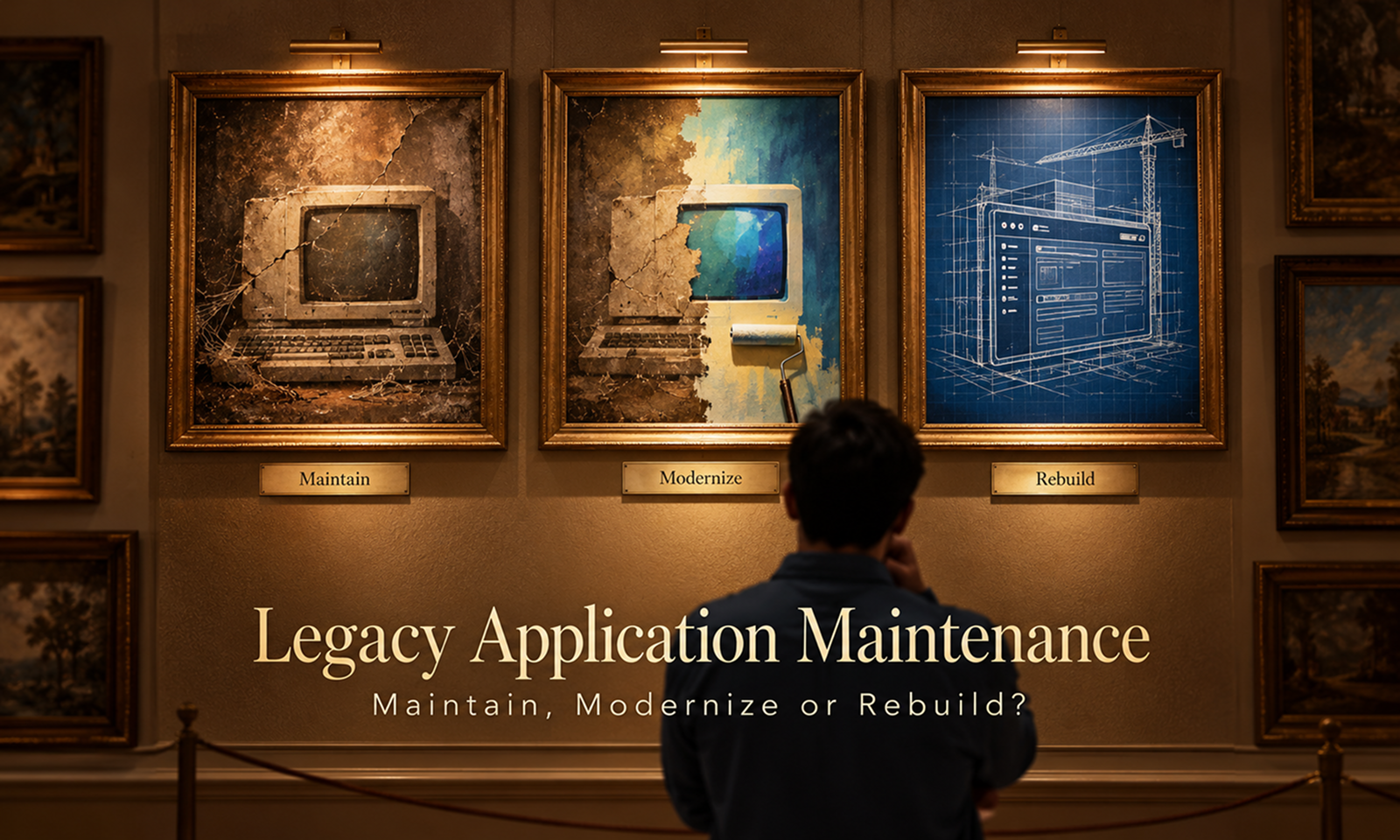
Once that question is answered, three broad paths become available:
Those options are not stages every legacy application must pass through. They are different interventions for different conditions.
Microsoft's current modernization guidance makes a similar point: teams should make the least amount of change required to achieve the desired business outcome within acceptable cost and risk. Sometimes that means replatforming or refactoring; sometimes the right answer is simply to continue operating the existing system and reassess later. Microsoft Cloud Adoption Framework: Modernization Preparation
That principle is central to how Levelworks thinks about legacy application maintenance. The purpose should not be to make old software look modern. It should be to improve the application's health enough to support the business safely and efficiently.
Calling software legacy because of its age is not very useful.
A better definition is that a legacy application is one whose technology, architecture or operating model increasingly constrains the organization that depends on it.
That constraint might appear as:
The application may still perform its core business function extremely well.
That distinction matters.
The fact that an application is technically dated tells you very little about whether replacing it is economically justified.
AWS's modernization-readiness guidance recommends evaluating applications through several lenses rather than making a purely technical decision: business fit, functional adequacy, technical adequacy, financial fit and modernization readiness. AWS: Evaluating Modernization Readiness
A useful legacy decision therefore starts with both sides of the system:
What business value is worth preserving?
and
What technical condition is preventing that value from being delivered efficiently?
Maintaining an existing legacy system is sometimes described as doing nothing.
That is a mistake.
There is a substantial difference between actively maintaining an older application and simply allowing an old application to deteriorate.
Maintenance can include keeping dependencies within supportable ranges, fixing defects, improving monitoring, patching security vulnerabilities, strengthening tests, documenting critical knowledge and removing the worst sources of operational friction.
The underlying application remains broadly intact.
Maintenance is often the right choice when:
AWS explicitly includes retain among its application strategies when an existing workload has no sufficient business justification for migration or modernization. AWS: Migration Strategies
That can be economically rational.
Imagine an internal order-management system that supports a stable process, has manageable operating costs, receives modest change and remains on supported technology.
Rebuilding it simply to obtain a newer technology stack may consume substantial money without producing an equivalent business benefit.
In that situation, disciplined maintenance may generate a much better return.
There is a limit.
An organization can keep almost any application alive if it is willing to spend enough engineering effort around its constraints.
That does not necessarily make maintenance sensible.
Watch for situations where the team increasingly has to:
At that point, the organization may no longer be maintaining the application.
It may be subsidizing its limitations.
[Internal Link: “What Happens When Your App Uses an Outdated Framework?”]
Modernization sits between preserving the current system and discarding it.
It is often the most misunderstood option because “modernization” can describe radically different amounts of change.
Microsoft separates modernization into approaches such as replatforming, refactoring and rearchitecting, depending on where the constraint exists. Replatforming changes the platform with minimal application change; refactoring changes code to address issues such as technical debt; rearchitecting changes fundamental system structure when the existing architecture prevents desired outcomes. Microsoft: Modernization Guidance
This distinction is useful because many legacy applications do not need everything modernized.
Suppose an application has:
Rewriting its business logic may solve nothing.
A better modernization program might move the database to a supported managed service, rebuild the deployment process and improve observability while leaving most business functionality intact.
Another application might have modern infrastructure but one tightly coupled billing module that makes every product change difficult.
The modernization target is then the billing architecture, not necessarily the rest of the application.
AWS recommends evaluating strategies at the component level rather than assuming every tier of an application needs the same treatment. One part might be replatformed while another is refactored or retained. AWS: Prioritization and Migration Strategy
That is an important principle for legacy maintenance:
Do not modernize the application because it is legacy. Modernize the constraint that is preventing the application from remaining healthy.
Change the operating platform while minimizing changes to application behavior.
Examples might include moving an aging self-managed database to a supported managed database or replacing obsolete infrastructure while preserving the application itself.
This makes sense when operational or platform risk is the problem rather than the business logic.
Improve parts of the existing code without replacing the entire application.
That may involve separating heavily coupled modules, improving testability, removing problematic dependencies or restructuring code that repeatedly slows maintenance.
Change fundamental architecture where the existing structure prevents required business outcomes.
For example, one tightly coupled deployment may make independent scaling or release of business-critical components impossible.
DORA's architecture research makes an important point here: the goal should not be adopting a fashionable architecture such as microservices. What matters is whether teams can test, deploy and change parts of the system without excessive coordination or cascading impact. DORA: Loosely Coupled Teams
A legacy monolith that allows safe, frequent change may be healthier than a badly designed collection of microservices.
Modernization should improve outcomes, not architecture diagrams.
One of the strongest arguments for modernization is that it can happen progressively.
Instead of replacing the entire application at once, a team can create a new implementation around selected capabilities and gradually move traffic or functionality away from the old system.
Martin Fowler's well-known Strangler Fig pattern describes exactly this approach: gradually create a replacement around an existing system until enough functionality has moved that the old implementation can eventually be retired. Martin Fowler: Strangler Fig
Imagine a legacy commerce platform containing:
Customer accounts
Orders
Pricing
Payments
Reporting
Inventory
The organization may not need to replace all six simultaneously.
Perhaps reporting is causing the greatest development bottleneck.
A new reporting capability can be introduced while ordering, pricing and inventory remain on the legacy system.
Later, another boundary can move.
The business continues operating while modernization proceeds.
That is often considerably safer than betting the entire application on one future cutover date.
Sometimes the application really has reached the point where incremental improvement is no longer attractive.
A rebuild means creating a new implementation of the required application capabilities rather than substantially evolving the existing codebase.
This is the most disruptive of the three choices and should normally require the strongest justification.
A rebuild becomes more reasonable when several conditions exist together.
For example:
Microsoft's application rationalization guidance includes rebuilding when a system is too outdated or inflexible to support required outcomes and a new implementation is justified. Microsoft Cloud Adoption Framework: Migration Strategies
AWS similarly treats refactoring or rearchitecting as the most complex migration strategies and recommends using them where less disruptive strategies cannot produce the required outcome.
A rebuild should therefore solve a structural problem that maintenance and targeted modernization cannot solve economically.
The problem with legacy applications is that they often contain more knowledge than their documentation reveals.
Years of production use accumulate:
Some of those rules exist only because somebody discovered an important edge case ten years ago.
When rebuilding, the team has to distinguish between:
old complexity that should disappear
and
old complexity that represents real business behavior.
That is difficult.
A rebuild often begins with an attractive objective:
Create a cleaner version of the existing application.
Then users identify more capabilities that the new system also needs.
Each one becomes another requirement.
The project gradually turns into reproducing years of accumulated behavior before the business receives meaningful benefit.
If the old application continues changing during the rebuild, the target moves at the same time.
Legacy applications often contain years of inconsistent, incomplete or historical data structures.
A rebuild must determine:
The new codebase may be the easiest part of the project.
Large replacements rarely switch instantaneously.
For some period, the organization may need to maintain both the old and new applications.
That can increase:
Those transition costs belong in the rebuild business case.
Engineers naturally prefer systems that reflect the technologies and design approaches they currently use.
That preference can produce expensive decisions.
Old code may be ugly but reliable.
Unfashionable architecture may still be well understood.
A modern rewrite may be aesthetically cleaner without making the business materially better.
Microsoft's current modernization planning guidance explicitly warns teams to avoid over-modernizing and recommends grounding modernization decisions in business value rather than technology enthusiasm. Microsoft: Plan Your Cloud Modernization
A rebuild should therefore have measurable outcomes.
For example:
“Use a modern stack” is not an adequate business outcome.
Legacy applications almost always contain technical debt.
The decision depends on where that debt sits and how expensive it is.
Debt concentrated in one heavily changed module may justify targeted refactoring.
Debt spread through almost every important component may strengthen the rebuild case.
The crucial metric is not the theoretical amount of technical debt.
It is the effect of that debt on:
[Internal Link: “How Technical Debt Affects the Health of Your Application”]
This is why technical-debt discussions should eventually become economic discussions.
If engineers dislike a module but rarely touch it and it performs reliably, fixing it may deliver little value.
If the same module delays every release, it deserves much more attention.
A useful legacy assessment can be organized around six questions.
Evaluate whether it still supports the business processes, customer experience and capabilities the organization needs.
If the business model itself has moved far beyond what the application was designed for, technical maintenance alone may have limited value.
Review important frameworks, runtimes, databases, libraries and infrastructure.
Unsupported technology increases security and operational risk, but the solution might be a targeted upgrade rather than a rebuild.
Look at the real engineering cost of changing the application.
Does a minor requirement require modifications across many unrelated areas?
Can components be tested independently?
Are releases risky?
Change friction often reveals architectural health more clearly than age does.
Consider documentation, code clarity, production telemetry and availability of technical knowledge.
An application that cannot be understood safely becomes increasingly expensive to maintain.
If one unhealthy component can be replaced independently, modernization becomes attractive.
If every component is inseparable from every other component, incremental change becomes much more difficult.
Specify the desired future state before choosing the intervention.
Without that step, “modernization” becomes an open-ended engineering program.
This is where Levelworks' App Health framework becomes particularly valuable for legacy applications.
Instead of asking whether the application looks old, evaluate how healthy it actually is.
Relevant aspects might reveal very different situations.
App Health aspect
Question for a legacy application
Current & Updated
Are important technologies still within supported ranges?
Secure
Can known vulnerabilities and security requirements be addressed effectively?
Observable
Can engineers understand production behavior?
Tested
Can important changes be verified with reasonable confidence?
Performant
Does the application still meet real workload requirements?
Scalable
Can it accommodate expected growth?
Integrable
Can it continue participating in the surrounding technology ecosystem?
Well Documented
Is important knowledge durable and transferable?
Seamlessly Updatable
Can changes reach production without disproportionate risk?
Compatible
Can the application continue operating across required environments and dependencies?
The resulting picture may show that the application is old but healthy.
Maintain it.
It may show that two or three aspects are creating most of the risk.
Modernize those areas.
Or it may show deterioration across almost every important dimension, with the existing architecture making meaningful correction impractical.
That strengthens the rebuild case.
App Health therefore helps move the conversation away from age and toward condition.
No table should make the decision automatically, but this one can make the trade-offs clearer.
Condition
Maintain
Modernize
Rebuild
Business functionality still fits
Strong fit
Strong fit
Possible
Technology remains supportable
Strong fit
Possible
Rarely needed for this reason alone
Limited technical debt
Strong fit
Sometimes
Weak justification
Specific components create constraints
Possible
Strong fit
Usually excessive
Architecture blocks important future needs
Weakening fit
Strong fit
Possible
Most of system requires replacement
Weak fit
Possible
Stronger fit
High business continuity requirement
Strong
Often supports incremental modernization
Raises rebuild transition risk
Poor testing/documentation
Can be improved
Increases modernization risk
Also increases rebuild discovery risk
Low strategic value
Maintain cheaply or retire
Usually weak case
Usually weak case
High strategic value and severe structural constraints
Temporary option
Strong candidate
Strong candidate if incremental path is poor
The decision does not always need to apply to the entire application.
A company might:
That can be far more rational than assigning one label to a twenty-year-old system containing many different components.
A rebuild usually has the largest visible project budget.
Maintenance often has the smallest.
That alone does not tell you which choice is cheaper.
Evaluate the cost over a realistic period.
followed by the expected future maintenance profile.
plus maintenance of the new system afterward.
AWS recommends incorporating both business and financial fit into modernization assessments rather than selecting a technical path in isolation.
The important comparison is therefore not:
What is cheapest this year?
It is:
Which option produces the best combination of business capability, application health, risk and total cost over the period we actually care about?
Organizations sometimes look at legacy software only as accumulated technical debt.
That misses half the picture.
A mature application can also contain accumulated business knowledge.
It may encode years of decisions about:
A good modernization program tries to preserve valuable knowledge while removing technical constraints around it.
That is one reason incremental approaches are often attractive.
You can improve the system while observing how the existing behavior actually works.
A complete rewrite asks the new team to rediscover much more of that knowledge upfront.
An important legacy discussion should also ask whether the application should continue existing at all.
If the software provides little strategic differentiation and a capable commercial platform now performs the same job, replacement with an existing product may deserve consideration.
Likewise, an application that no longer serves meaningful business needs might be retired instead of modernized.
Both AWS and Microsoft include retire and product replacement among legitimate application rationalization strategies.
That matters because engineering teams can become trapped in a false choice:
Spend money keeping this application alive or spend even more rebuilding it.
Sometimes the best legacy modernization project is shutting something down.
Legacy modernization programs can become permanent because there is always something else that could be improved.
Define the outcome before starting.
For example:
Move all critical components onto supported technology, eliminate the manual deployment process and reduce coupling around the order-processing module.
That has an endpoint.
Modernize the legacy platform
does not.
A good roadmap should connect every modernization activity to a specific business or App Health constraint.
Once the required outcome has been reached, return to ordinary maintenance.
Modernization should not become a permanent excuse for rewriting working software.
A rebuild does not eliminate legacy maintenance immediately.
If the replacement will take eighteen months, the existing system still has to operate during those eighteen months.
It may still require:
This creates a difficult balancing act.
Too much investment in the old application diverts capacity from replacement.
Too little creates operational risk before the new application is ready.
The sensible approach is usually minimum responsible maintenance: continue investing enough to keep the existing application safe and reliable while avoiding unnecessary enhancements that will soon disappear.
That transition deserves explicit budget and ownership.
Legacy applications create a dangerous incentive problem.
A company specializing in large rebuilds can easily conclude that rebuilding is necessary.
A maintenance-only provider may keep an application alive long after modernization would be economically sensible.
The stronger approach is diagnosis before intervention.
For Levelworks, App Health provides that foundation.
Understand which parts of the application remain healthy, which conditions are deteriorating, where technical constraints are genuinely affecting the business, and how much change is required to correct them.
Then choose the smallest intervention capable of producing the required outcome.
That may mean another five years of disciplined maintenance.
It may mean a twelve-month incremental modernization program.
It may mean accepting that the current application can no longer become the system the business needs and designing a replacement.
The value is not in preferring one answer.
It is in being able to justify the answer technically and economically.
[Internal Link: “How to Take Over an App Built by Another Development Team”]
An application does not become a rebuild candidate because its framework is unfashionable, its architecture looks old or somebody has proposed a cleaner system diagram.
It becomes a candidate when its current condition prevents the business from getting what it needs and the cost, risk or limitation of correcting that condition incrementally is worse than creating a replacement.
Until then, maintenance and modernization remain powerful options.
That is an important distinction because the three strategies create very different kinds of value.
Maintenance protects value that already exists.
Modernization preserves that value while removing specific constraints.
Rebuilding trades the existing technical foundation for a new one when preserving it no longer makes sense.
The hardest legacy application decision is rarely identifying everything that is wrong with the old system.
It is deciding how much of what already works is still worth keeping.