A healthcare application can be online while something clinically important is broken.
Patients may still log in and book appointments while an integration failure prevents new laboratory results from reaching the application. Infrastructure monitoring remains green because the servers are healthy, yet the information users depend on is incomplete.
That is what makes healthcare application maintenance different from simply keeping software available.
Healthcare systems often need to protect three things simultaneously: confidentiality, integrity and availability. Sensitive health information must remain protected, the information presented to users must remain accurate, and authorized people need dependable access when they need it.
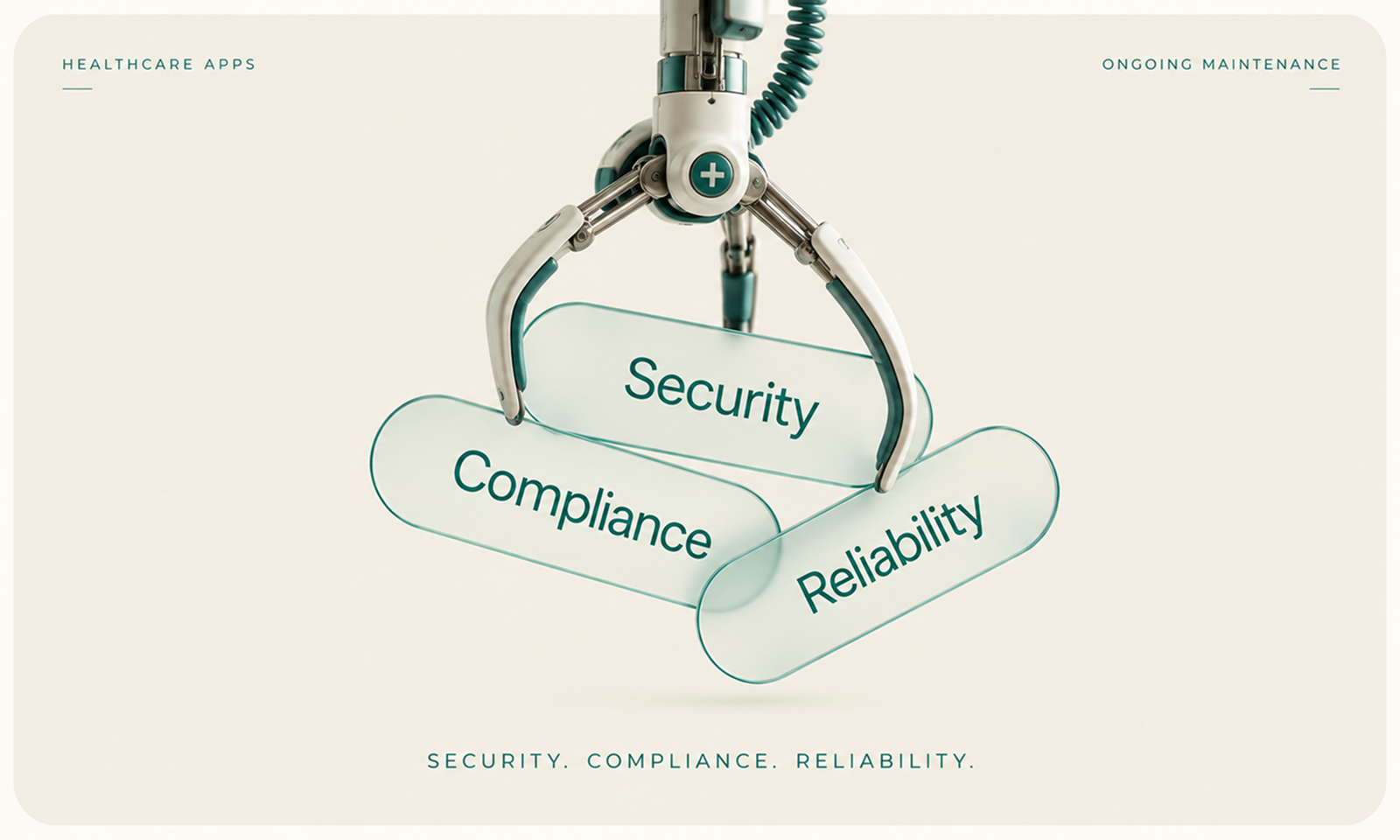
Maintenance therefore has to preserve security controls, application reliability and applicable compliance obligations as the product changes.
For Levelworks, this connects most directly to Secure, Resilient, Compliant, Observable, Integrable, Error Free, Tested and Current & Updated App Health.
Healthcare data rarely remains inside one application database.
It may also appear in:
For organizations subject to HIPAA, HHS requires risk analysis to consider electronic protected health information created, received, maintained or transmitted by the organization. HHS also describes risk analysis as an ongoing process that should be revisited when systems or operations change. HHS: HIPAA Risk Analysis
NIST's current HIPAA security guidance similarly emphasizes understanding where ePHI is stored, received, maintained and transmitted when assessing security risk. NIST SP 800-66 Rev. 2
That means seemingly ordinary maintenance changes can alter the application's security boundary.
If a new error-monitoring tool begins capturing request payloads, for example, health information may suddenly exist in a system that was never included in the original security review.
The maintenance team should therefore update its data-flow understanding whenever new services, storage locations or integrations are introduced.
Healthcare software does not operate under one universal compliance framework.
In the United States, the HIPAA Security Rule applies to covered entities and their business associates with respect to electronic protected health information. HHS: HIPAA Security Rule
A consumer wellness app offered directly to individuals may sit outside that relationship and encounter different obligations.
For example, the FTC's Health Breach Notification Rule can apply to certain health applications and vendors of personal health records not covered by HIPAA. The rule was updated in 2024 to clarify its application to health apps and similar technologies. FTC: Health Breach Notification Rule
The practical maintenance lesson is straightforward:
Determine compliance from the application's actual role, users, data and jurisdiction—not simply because it is described as a healthcare app.
Then revisit that position when the product changes.
A new type of health data, external provider or market can change the compliance picture even when the underlying regulations have not changed.
[Internal Link: “Application Compliance Maintenance: Why Compliance Is Not a One-Time Project”]
Healthcare applications frequently contain several roles with different information needs.
Depending on the product, these may include patients, physicians, nurses, administrators, billing staff or care coordinators.
Maintenance releases can unintentionally expand access.
A redesigned administration page might expose more patient information than intended. A new API endpoint may return records correctly for authorized users but fail to verify whether the user should have access to that particular patient.
When roles, permissions or sensitive workflows change, test both questions:
Can the intended user perform the task?
and
Can someone without the required authority reach the same information or action?
The second question is just as important as the first.
For HIPAA-regulated environments, NIST's guidance includes controls around access, authentication, audit and accountability as important parts of protecting ePHI.
For Levelworks, this is the practical connection between Secure App Health and ongoing maintenance: controls have to survive product change rather than merely passing an initial review.
Healthcare applications often need to reconstruct what happened after an event.
Who accessed a record?
Who changed information?
When did it happen?
Which administrative action was performed?
New features and architectural changes can quietly weaken that evidence.
A workflow moved to a new service, for example, may no longer record the same user or transaction context as the old implementation.
When sensitive functionality changes, verify that important access and actions remain traceable.
At the same time, avoid indiscriminate logging. Detailed logs can become another source of sensitive information if full clinical records, credentials or unnecessary personal data are copied into them.
The aim is useful auditability without creating another uncontrolled health-data store.
Security maintenance should not depend on the annual audit discovering something first.
Healthcare applications use frameworks, libraries, runtimes, operating systems and cloud services that continue changing after launch.
Maintenance should include a repeatable process for:
HHS's Healthcare and Public Health sector Cybersecurity Performance Goals include vulnerability management, asset inventory, configuration management, centralized logging and incident preparedness among recommended cybersecurity practices. HHS: HPH Cybersecurity Performance Goals
An accurate technology inventory matters because teams cannot patch systems they do not realize they still depend on.
This is where Secure and Current & Updated App Health reinforce one another. Staying reasonably current reduces the amount of old technology the security process has to defend indefinitely.
[Internal Link: “Application Security Maintenance: What Needs to Happen After Launch?”]
Healthcare applications frequently rely on outside providers for hosting, messaging, telehealth, identity, analytics, AI or healthcare-data exchange.
A new vendor can change who receives sensitive information and where that information is processed.
When adding or materially changing a third party, establish:
Where HIPAA applies, relationships with business associates and relevant subcontractors may also have specific contractual and security implications.
The important maintenance principle is that successful technical integration does not complete the vendor review.
If a service was originally approved for anonymous system metrics and later begins receiving identifiable patient information, the risk has changed even though the vendor has not.
Healthcare reliability should be measured from the workflow users depend on.
Consider a laboratory-result flow:
Lab system
↓
Integration/API
↓
Healthcare application
↓
Patient or clinician record
The application's servers may remain available while the integration has stopped delivering new results.
That is why monitoring should ask whether important healthcare processes are completing successfully.
Depending on the product, these might include:
A technically successful API response is useful.
Knowing that the correct clinical information reached the correct record is much stronger evidence.
Healthcare systems frequently depend on other healthcare systems.
Failures can appear as:
Track both connectivity and outcome.
For example, if the system normally receives thousands of updates from an EHR every day and suddenly receives none, that should attract attention even if the API itself continues returning successful health checks.
Interoperability standards can also evolve.
For products participating in the US ONC Health IT Certification Program, USCDI Version 3 became the baseline for relevant certification requirements from January 1, 2026, alongside updated requirements affecting standardized APIs. ONC: HTI-1 Final Rule
That requirement does not apply to every healthcare application, but it illustrates why relevant standards and certification obligations need to remain part of maintenance when they do apply.
Healthcare security conversations often concentrate on unauthorized disclosure.
Incorrect patient information can be just as serious operationally.
Changes involving:
should be tested for correctness, not simply successful completion.
Imagine migrating a large set of patient records.
The migration script completes without error, but one field is mapped incorrectly.
From an infrastructure perspective, the release succeeded.
From the application's perspective, the data is wrong.
HHS defines integrity under the HIPAA Security Rule in terms of information not being altered or destroyed in an unauthorized manner, alongside confidentiality and availability. HHS: HIPAA Security Rule
For maintenance teams, that makes data validation part of reliability work.
Not every technical failure deserves the same response.
Severity should reflect what users can no longer do.
Examples that may warrant immediate attention include:
Gradual storage growth or a delay in a non-critical administrative report may require investigation without becoming an emergency.
The exact classification depends on the application.
A scheduling outage in one product may be inconvenient. In another, scheduling may directly affect access to urgent care.
The maintenance team therefore needs enough domain context to understand the consequence of technical failure rather than ranking incidents solely by which component went down.
A backup only proves useful when the organization can restore what it needs.
For HIPAA-regulated organizations, contingency-planning requirements address data backup, disaster recovery and emergency-mode operation. HHS also recommends periodically testing contingency arrangements. HHS: Ransomware and HIPAA
Healthcare maintenance should periodically answer:
That last question matters particularly for integrated healthcare systems.
If the application is unavailable for four hours while an external clinical system continues creating records, restoring the database does not automatically restore the complete workflow.
The team needs to understand how missed information will be replayed, recovered or reconciled.
[Internal Link: “Backup and Disaster Recovery: What Every App Maintenance Plan Needs”]
Not every release needs the same level of security or compliance involvement.
A better approach is to identify changes that should trigger additional review.
Change
Additional maintenance attention
New sensitive health-data field
Privacy, security and retention review
New user role
Authorization testing
New healthcare integration
Security, mapping and failure testing
Clinical data migration
Integrity checks and recovery planning
Authentication change
Access-control regression testing
New vendor handling health data
Security/compliance review
Critical workflow redesign
End-to-end reliability testing
This keeps the release process proportionate.
A minor copy change should not need the same review as a redesign of patient access controls.
The goal is to recognize which changes can alter the application's risk and compliance position.
Regulatory change is only one source of compliance drift.
Product change is another.
An application may introduce a new data type, vendor, workflow or market without any regulation changing at all.
HHS explicitly recommends revisiting HIPAA risk analysis as new technologies and changes to business operations are introduced. HHS: HIPAA Risk Analysis
The same operating principle is useful more broadly:
When a meaningful product change alters data, access, vendors or critical workflows, check whether the compliance assumptions around that functionality still hold.
Do not wait for an annual review to discover that the application implemented six months earlier no longer matches the system that was originally assessed.
Healthcare applications benefit from preserving technical evidence such as:
This does not mean building processes solely for auditors.
Good technical controls often create evidence naturally.
Version control records changes. CI/CD records deployments. Security tooling records findings and remediation. Incident systems preserve operational history.
For Levelworks, this is where Compliant, Tested, Observable and Well Documented App Health support one another.
Area
Ongoing maintenance question
Sensitive data
Do we know where health information currently exists?
Access
Do current permissions enforce intended boundaries?
Auditability
Can important access and changes be reconstructed?
Technology
Are vulnerable and unsupported components being addressed?
Vendors
Do third-party access and data flows still match expectations?
Healthcare workflows
Are critical processes completing end to end?
Integrations
Is health data arriving correctly and on time?
Data integrity
Have changes preserved accurate patient information?
Reliability
Are incidents prioritized by healthcare impact?
Recovery
Can services and complete data be restored?
Compliance
Have product or regulatory changes altered requirements?
Evidence
Can the organization show important controls are operating?
Healthcare maintenance should protect more than uptime.
Authorized users need confidence that the information they see is available when needed, belongs to the correct patient, has not been altered unexpectedly and remains protected from people who should not have access.
That is why security, reliability and compliance are difficult to separate in healthcare applications.
Weak integrations undermine data reliability. Poor observability makes security incidents harder to investigate. Aging technology increases security risk. Recovery procedures that ignore missed external data can restore an application while leaving its records incomplete.
Levelworks' App Health framework makes those relationships easier to see. A healthcare application cannot meaningfully be Compliant while it is insecure, cannot be Resilient if critical information cannot be recovered, and cannot remain reliably Integrable if healthcare-data failures go undetected.
The real maintenance standard is therefore not simply whether the application stays online.
It is whether the organization can continue trusting the system—and the healthcare information moving through it—as the application evolves.