A money transfer can fail in a way that ordinary uptime monitoring barely notices.
The customer's account shows the debit. The receiving account has not been credited. The payment provider says the instruction was accepted. A background worker is retrying the transaction, while customer support is looking at a different status again.
The application is online.
That is not the same as the application being healthy.
For fintech applications, maintenance has to protect something more demanding than availability. Financial state has to remain correct, security controls have to survive continual product change, failures need to recover without duplicating or losing transactions, and the system must continue meeting whatever regulatory and contractual obligations apply to the business.
Those responsibilities also interact. A badly implemented retry is a reliability problem until it creates a duplicate financial transaction. Excessive production access is an operational shortcut until it becomes a security and audit problem. An outdated dependency is routine maintenance until a vulnerability affects a system handling financial data.
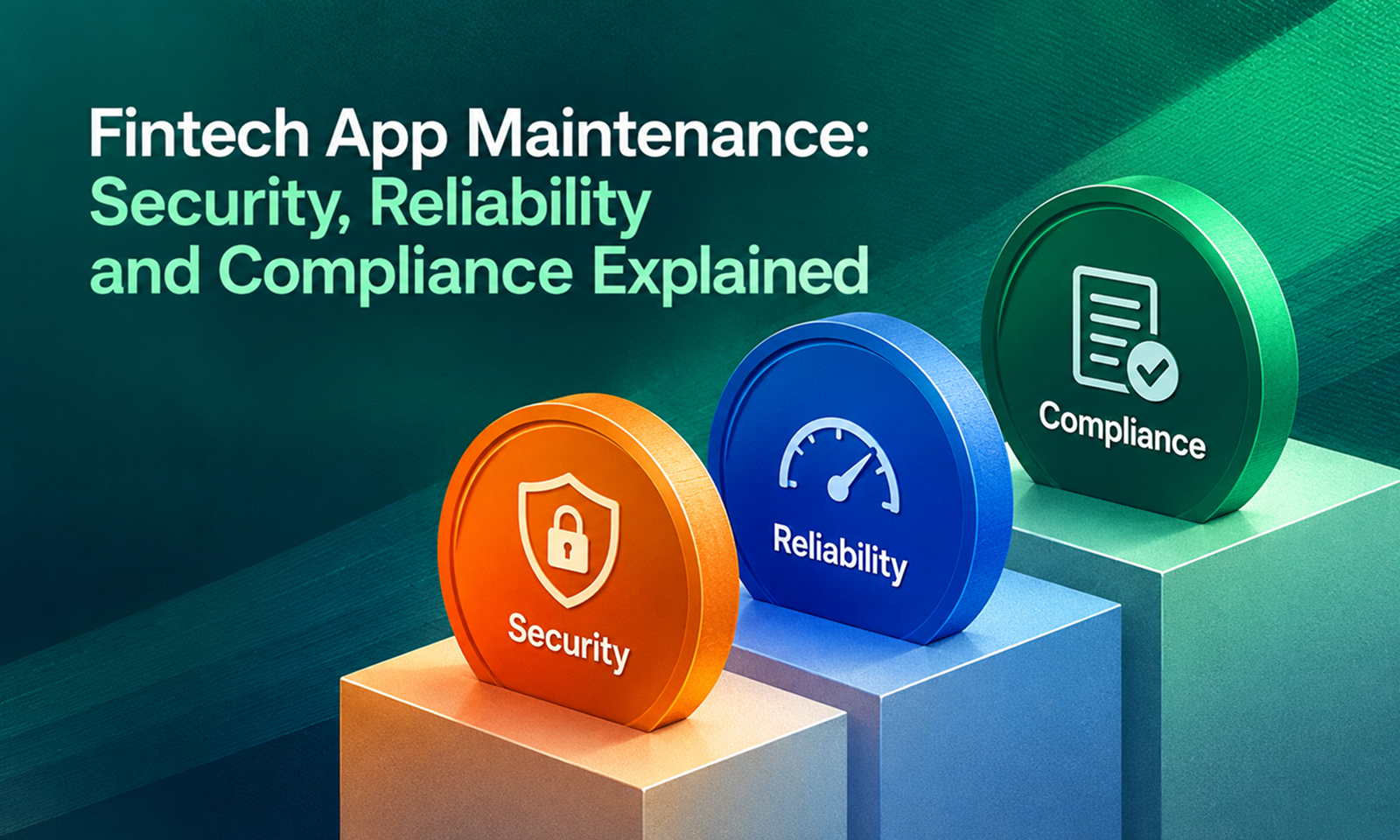
That is why fintech application maintenance needs to treat security, reliability and compliance as connected operating concerns, rather than three periodic exercises.
For Levelworks, the most relevant App Health aspects are Secure, Resilient, Error Free, Observable, Tested, Current & Updated, Integrable and Compliant.
For many applications, the clearest failure is that something stops working.
Fintech failures can be more subtle because the system continues operating while different components disagree about the financial state of a transaction.
Consider a payment moving through:
Customer request
↓
Fintech application
↓
Payment provider / banking rail
↓
Webhook or status update
↓
Internal transaction record
↓
Ledger / balance
↓
Customer-facing status
Maintenance needs to verify that these states remain consistent.
A successful API call cannot automatically be treated as proof that the financial outcome completed successfully. Depending on the payment architecture, a transaction may later fail, remain pending, be reversed or require asynchronous confirmation.
Useful monitoring therefore looks for anomalies such as:
The exact states differ between products, but the principle does not:
Monitor financial outcomes, not merely technical requests.
For fintech maintenance, Error Free App Health includes transactional correctness, not simply an absence of exceptions.
Distributed financial systems occasionally disagree.
The dangerous condition is not necessarily that disagreement happens; it is that nobody detects it.
Reconciliation compares records from separate sources to identify unexpected differences.
For example:
Internal payment records
vs
Payment-provider records
or:
Expected settlement
vs
Actual settlement
The specific reconciliation process depends on the financial product, but automated comparison provides an important backstop against failures that request-level monitoring misses.
If a webhook fails, a worker crashes or an external service times out at an awkward moment, reconciliation can expose the resulting state mismatch.
Maintenance teams should therefore monitor:
A system that processes financial transactions should not depend solely on every distributed event succeeding perfectly the first time.
Retries are necessary in distributed financial systems because networks fail and external services become temporarily unavailable.
But retries can be dangerous when the operation changes financial state.
Suppose an application sends a transfer request and times out before receiving the provider's response.
Did the provider process it?
If the application blindly sends the request again, it may create a duplicate transaction.
Maintenance testing should therefore verify that financially sensitive operations behave correctly when:
Where supported, idempotency controls can help ensure that repeating the same intended operation does not create an unintended duplicate outcome.
These cases belong in regression testing because changes to queues, SDKs, provider integrations or transaction workflows can alter previously safe behavior without changing the visible interface.
Financial applications often combine several powerful capabilities: viewing balances, moving money, changing beneficiaries, modifying account details or administering other users.
Access-control mistakes can therefore have unusually serious consequences.
Maintenance should revisit authentication and authorization whenever teams change:
OWASP's current API Security guidance continues to place broken object-level authorization, broken authentication and broken function-level authorization among major API risks. OWASP: API Security Top 10
That has a very practical implication for fintech maintenance.
Testing an endpoint should not stop at:
Can an authorized user successfully perform this operation?
It should also ask:
Can this user perform the operation on an account, transaction or resource they do not own?
Role changes are particularly sensitive. A new operations dashboard, for example, may expose functionality that was previously available only to a smaller administrative group.
[Internal Link: “Application Security Maintenance: What Needs to Happen After Launch?”]
Fintech systems are frequently integration-heavy.
They may communicate with:
Every integration expands both the operational and security surface.
OWASP's API Security Top 10 also identifies improper inventory management and unsafe consumption of third-party APIs as material risks.
Maintenance should therefore maintain a current view of important APIs, versions, credentials, owners and dependencies.
For financially critical integrations, monitor both the technical call and the business result.
An external transfer API returning successfully is useful telemetry.
Knowing that transfers requested, transfers accepted and transfers ultimately completed reconcile correctly is much stronger telemetry.
[Internal Link: “How to Monitor the Health of Your App’s APIs and Integrations”]
Fintech applications are attractive targets precisely because access to the application may provide access to money or sensitive financial information.
Security maintenance needs a routine operating path for:
NIST's Secure Software Development Framework recommends integrating secure-development practices throughout the software lifecycle so organizations can reduce vulnerabilities, mitigate those that reach production and address root causes rather than repeatedly treating symptoms.
That last point matters.
A vulnerability should not always end with:
Patch deployed.
If the problem resulted from an unsafe coding pattern, weak dependency process or missing security test, maintenance should consider whether the same weakness can occur elsewhere.
For Levelworks, this is where Secure and Current & Updated App Health reinforce one another. Staying current reduces the amount of unsupported or vulnerable technology the security process has to compensate for.
Fintech applications need detailed telemetry because investigating financial discrepancies without evidence is extremely difficult.
But detailed telemetry creates its own risk.
Logs, traces and error reports should not casually become secondary stores for sensitive information.
Review logging when introducing new:
Ask what is being recorded and whether it is genuinely needed.
Examples requiring particular care may include payment data, credentials, authentication tokens, personal financial information and other sensitive account details.
The maintenance objective is not to reduce observability.
It is to create enough evidence to diagnose production safely without copying sensitive data into places where it does not belong.
Google SRE's four golden signals—latency, traffic, errors and saturation—provide a useful foundation for operating distributed applications. Google SRE: Monitoring Distributed Systems
For fintech, those infrastructure and service signals should be connected to financial workflows.
For example:
Technical signal
Financial interpretation
API latency
Are customers waiting unusually long for transfers or account actions?
Error rate
Which financial operations are failing?
Queue depth
Are settlements, notifications or transaction-processing jobs falling behind?
Saturation
Is capacity approaching a level where financially important workflows may degrade?
Segmentation matters as well.
A platform-wide error rate may appear normal while one banking integration is failing almost completely.
Monitor important financial operations independently rather than averaging everything into one “application health” number.
Fintech systems often rely heavily on queues and event-driven processing.
A user action may trigger later:
The initial request can therefore succeed while downstream work fails.
Monitor more than queue length.
Useful measures include:
The age of the oldest job often tells a more useful story than the raw queue size.
A queue of 5,000 rapidly processing events may be healthy. Ten events stuck for several hours may represent financially important failures.
A fintech application can be well engineered and still depend on systems it does not control.
When a banking provider, identity platform or payment processor fails, your maintenance team may not be able to repair that provider.
It can still control how your application responds.
Review:
The key question is:
What state does our application enter when this external service becomes unavailable halfway through a financial operation?
A good answer is rarely “keep retrying indefinitely.”
Dependency failure needs predictable behavior and a recovery path.
That is Resilient App Health in practical terms.
Fintech applications may have strong backup policies and still have weak recoverability.
Maintenance should verify that recovery processes still match the current system.
Changes to databases, storage, encryption, infrastructure or integrations can invalidate old procedures.
Periodically establish whether the team can answer:
The financial state after restoration deserves particular attention.
Recovering a database is only part of the problem if external providers continued processing transactions while your system was unavailable.
A release that alters financial logic deserves stronger controls than a cosmetic update.
Testing depth should follow risk.
Changes affecting areas such as:
should receive appropriate automated and targeted regression testing before deployment.
NIST's SSDF emphasizes integrating secure practices directly into development and change processes rather than applying security as a separate final step.
For regulated US financial institutions, the FFIEC's 2024 Development, Acquisition, and Maintenance guidance similarly addresses maintenance and change-management practices as part of broader technology risk management. FFIEC: Development, Acquisition, and Maintenance Guidance
The exact regulatory applicability depends on the organization, but the engineering principle is sound for fintech generally: high-impact financial changes need traceability, controlled testing and a clear path to recovery.
There is no single universal “fintech compliance checklist.”
A payment company, lender, digital bank, investment platform and insurance application may fall under very different requirements depending on:
Maintenance therefore needs to watch compliance from two directions.
Regulators, standards bodies and contractual frameworks update requirements.
The application may need corresponding technical or operational changes.
Even if the rules remain unchanged, a new feature can alter compliance scope.
Adding card-data processing, expanding into another jurisdiction or introducing a new third-party provider can change which obligations apply.
That is why Compliant App Health cannot be established once at launch and assumed indefinitely.
[Internal Link: “Application Compliance Maintenance: Why Compliance Is Not a One-Time Project”]
Organizations that store, process or transmit payment-card data may have obligations under PCI DSS depending on their role and payment architecture.
PCI SSC published PCI DSS v4.0.1 as a revision to v4.0, and the requirements originally designated as future-dated became effective on March 31, 2025. PCI Security Standards Council: PCI DSS v4.0.1
PCI SSC also explicitly describes its standards as evolving in response to changing payment-industry threats, risks and security practices. PCI SSC: Maintaining Compliance When Standards Change
The maintenance lesson is broader than PCI itself.
Passing an assessment once does not freeze the application in a compliant state. Changes to payment flows, dependencies, infrastructure, access or supporting services can affect the controls that were originally assessed.
For financial entities within its scope in the European Union, the Digital Operational Resilience Act (DORA) has applied since January 17, 2025.
DORA addresses areas including ICT risk management, incident management, digital operational resilience testing and ICT third-party risk. European Securities and Markets Authority: DORA
The European Banking Authority also notes that covered entities need information about their contractual arrangements with ICT third-party providers to support third-party risk management and regulatory oversight. European Banking Authority: DORA Registers of Information
Not every fintech company is subject to DORA.
For those that are, however, application maintenance cannot be treated purely as software upkeep. Operational resilience, technology dependencies and third-party services become part of a regulated control environment.
Fintech products commonly depend on cloud services, financial infrastructure and specialist vendors.
Outsourcing a capability does not necessarily remove responsibility for the resulting risk.
DORA, for example, expressly creates an ICT third-party risk-management framework for covered EU financial entities.
The FFIEC likewise highlights the interconnectedness of financial institutions' technology assets, processes and third-party service providers in its architecture and operations guidance. FFIEC: Architecture, Infrastructure, and Operations
Maintenance teams therefore need a current understanding of:
A vendor relationship that was low-risk when introduced may become critical as more financial workflows begin depending on it.
Fintech compliance often requires more than having the right policy documents.
Technical evidence matters.
Depending on the applicable framework, useful evidence may include:
This is another reason maintenance practices matter.
Version control, automated testing, deployment pipelines, observability and documented operational procedures do more than improve engineering productivity. They can also create repeatable evidence about what changed, when it changed and how controls were applied.
The goal should not be producing evidence solely for an audit.
Well-designed controls create evidence naturally as the team operates the application.
The exact obligations depend on the product and jurisdiction, but the recurring engineering concerns can be summarized like this:
Area
Maintenance attention
Transaction integrity
Detect mismatched or incomplete financial states
Reconciliation
Compare independent transaction records and resolve discrepancies
Retries
Prevent duplicate financial operations
Authentication
Monitor and test login, recovery and MFA changes
Authorization
Verify users cannot access another user's financial resources
APIs
Track inventory, security, versions and business outcomes
Vulnerabilities
Patch dependencies, runtimes and infrastructure
Sensitive data
Keep unnecessary financial information out of logs and tools
Reliability
Monitor latency, errors, workload and capacity around critical financial journeys
Async processing
Watch queues, retries, failed jobs and processing delay
Third parties
Monitor dependencies and plan for partial failure
Recovery
Test restoration and post-recovery reconciliation
Releases
Apply stronger controls to financial-state changes
Compliance
Track relevant regulatory and standards changes
Evidence
Preserve traceability of changes, tests, incidents and controls
For many products, a temporary defect creates inconvenience.
In fintech, a small software defect can create uncertainty about whether money moved, whether somebody accessed information they should not have, or whether a financial record can still be trusted.
That changes what good maintenance looks like.
It is not enough for servers to remain available or for support tickets to be resolved quickly. Financial state needs to reconcile, access controls need to survive continual product change, dependencies need to remain supportable, failures need safe recovery paths, and compliance controls need to remain aligned with the application that actually exists in production.
That is also why Levelworks' App Health aspects become particularly connected in fintech. Secure without Observable makes incidents difficult to investigate. Resilient without Error Free can keep an application available while incorrect transactions continue processing. Compliant without Current & Updated becomes increasingly difficult to sustain as technology ages.
A healthy fintech application ultimately has to provide something more demanding than uptime: confidence that when the application says a financial event happened, the systems, records and controls behind that statement agree.