A small change to an enterprise application rarely stays small because of the number of systems and people around it.
An approval-rule change in a procurement platform may touch identity, an ERP integration, notification services, reporting logic and a shared database. The code modification itself might take an hour. Understanding who owns each dependency, arranging the right testing, coordinating the release and knowing what to watch afterward can take far longer.
That is the defining maintenance problem in enterprise software. Complexity does not come only from the size of the codebase. It comes from interdependence: applications, teams, vendors, infrastructure, data and business processes all relying on one another.
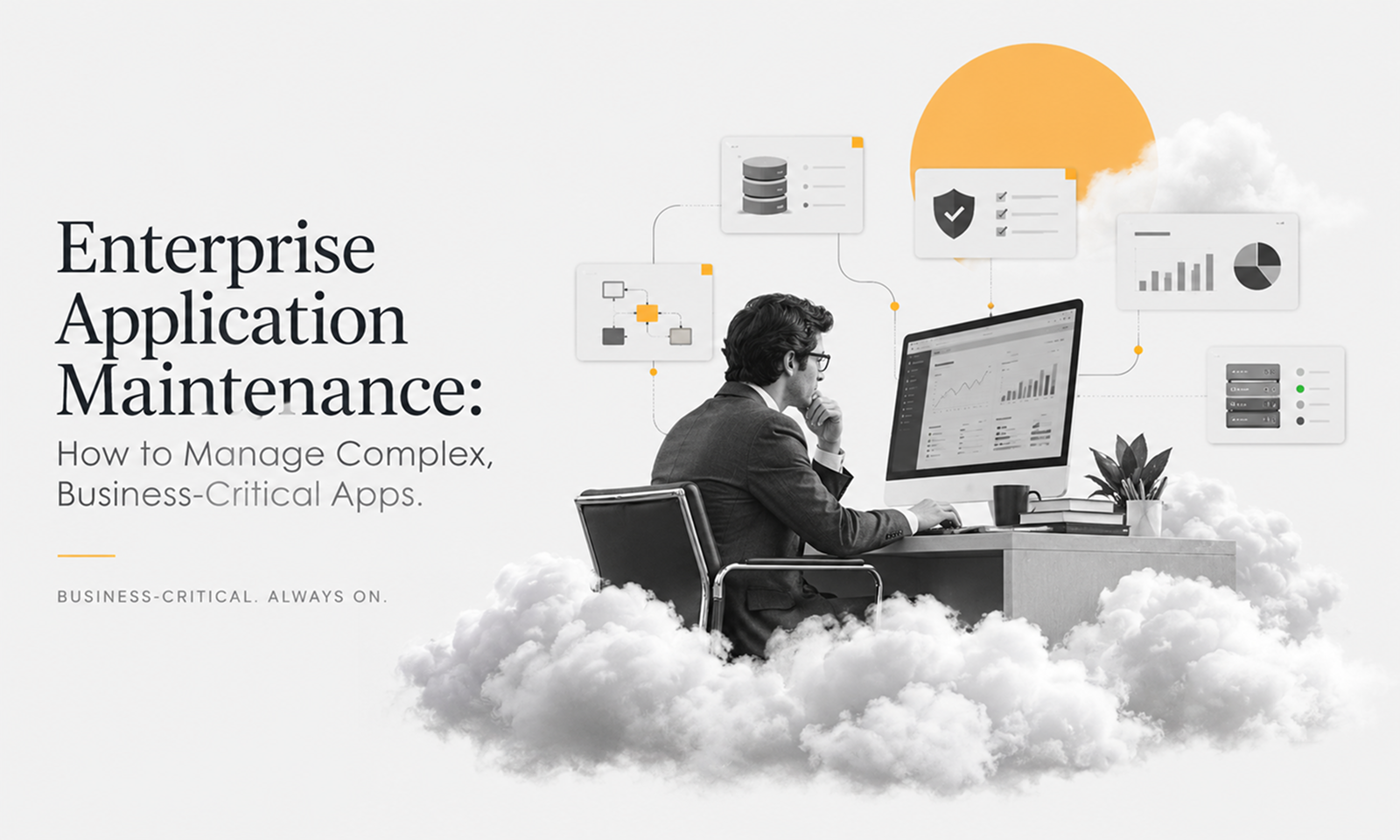
Managing a business-critical enterprise application therefore requires more than a capable maintenance team. It requires a clear operating model for criticality, ownership, dependencies, change, observability, incidents and technology lifecycle.
Microsoft's Azure Well-Architected Framework describes a workload as the combination of application resources, code, data and supporting infrastructure that works together to achieve a business outcome. It also emphasizes collaboration between the workload team and centralized functions such as security, networking, architecture and compliance. Microsoft: Azure Well-Architected Framework Workloads
That is a useful model for enterprise maintenance: shared responsibility cannot be allowed to become unclear responsibility.
For Levelworks, the most relevant App Health aspects are Observable, Resilient, Secure, Current & Updated, Tested, Well Documented, Integrable and Seamlessly Updatable. The objective is not to maximize every aspect equally. It is to understand which conditions are necessary for a particular business-critical service and ensure somebody is accountable for maintaining them.
Enterprise maintenance scopes are often technically neat but operationally incomplete.
For example:
The application team owns the procurement platform.
Yet procurement may depend on corporate identity, ERP master data, supplier APIs, an approval engine and a reporting system.
If employees cannot approve purchases because identity authentication is unavailable, it makes little difference that the procurement application's own servers remain healthy.
Maintenance should therefore begin with the business service boundary.
Identify the important business outcome and then map the systems required to deliver it.
AWS's reliability guidance recommends mapping technical components to the business functions they support and identifying which are business-critical. The reason is practical: not every component deserves the same investment in resilience or recovery. AWS: Identify Business-Critical Components
For each important business service, establish:
This gives every later maintenance decision a business context.
Enterprise applications typically depend on many teams.
The application team may own the code while identity belongs to a platform team, databases to another group, networking to central infrastructure and several integrations to outside vendors.
That structure is normal.
The danger appears when something fails between those boundaries and nobody clearly owns the next action.
For every important dependency, maintenance teams should know:
Microsoft's workload guidance recommends cross-disciplinary workload teams supported by centralized organizational functions. The workload team does not need to perform every specialist function itself, but the contributors should operate around the success of the same workload.
A useful test is:
If this dependency starts failing outside business hours, do we already know who can act?
If the answer requires searching chat history for someone who “probably knows,” ownership is not sufficiently defined.
[Internal Link: “Building an Effective App Maintenance Team: Roles, Skills and Structure”]
An enterprise may operate hundreds of applications.
Treating all of them as mission-critical wastes money and creates unnecessary process.
A better approach is to classify applications or business services according to the consequence of failure.
Tier
Typical consequence
Maintenance implication
Tier 1: Business-critical
Significant operational, financial or customer impact
Strong monitoring, rapid response, tested recovery and tighter release controls
Tier 2: Important
Material disruption but temporary alternatives exist
Defined support, monitoring and recovery
Tier 3: Standard
Limited business impact
Simpler controls and business-hours support may be sufficient
Do not adopt arbitrary availability targets simply because another organization calls a system “Tier 1.”
Criticality should come from business impact.
That classification can then drive:
A payroll system immediately before payroll processing may justify very different maintenance safeguards from an internal directory used occasionally by one department.
Enterprise architecture changes continuously.
A new service is introduced. A database is moved. Another business unit begins consuming an API. A vendor changes.
Architecture diagrams created during implementation can therefore become misleading.
For business-critical applications, maintain a practical dependency map showing how important workflows move through the estate:
Business process → application → shared services → data/infrastructure → external systems
The goal is not exhaustive documentation.
It is understanding blast radius.
If corporate identity changes, which applications could be affected?
If a shared integration platform is unavailable, which business functions stop?
If an API version is retired, which downstream systems must migrate?
DORA's research on loosely coupled teams shows that tightly coupled systems increase coordination requirements and make small changes more capable of producing cascading effects. Importantly, DORA also notes that this is not simply a question of using modern architectures: organizations can achieve independent change even with older technology, while poorly designed microservices can remain highly coupled. DORA: Loosely Coupled Teams
Enterprise maintenance does not need to eliminate every dependency.
It needs to know which ones matter and reduce unnecessary coupling where it repeatedly creates maintenance friction.
Enterprise organizations can have dozens of dashboards while still failing to notice that an important business process is broken.
Infrastructure health is necessary, but it is not enough.
Monitor the workflows people depend on.
Examples might include:
Microsoft's current observability guidance recommends aligning telemetry with workload-health and business models, correlating information across components, and defining alerts around meaningful operational conditions. Microsoft: Designing a Monitoring System
For complex enterprise systems, monitoring should help engineers answer:
Where did this business workflow stop?
rather than only:
Which servers are reporting errors?
That is the practical meaning of Observable App Health at enterprise scale.
Enterprises frequently respond to production risk by adding approvals.
Eventually, even a small maintenance release may require several manual sign-offs despite having automated tests, peer review and controlled deployment.
More approval does not automatically create safer software.
DORA's research on change approval recommends moving assurance closer to the work through peer review, automated testing, continuous integration and monitoring while reserving greater scrutiny for changes that actually carry greater risk. DORA: Streamlining Change Approval
An enterprise might therefore distinguish between:
Change
Appropriate treatment
Low-risk configuration update with automated validation
Standard delivery path
Normal application change
Peer review, testing and automated release controls
High-risk database migration
Additional review and recovery planning
Shared platform change
Cross-team impact assessment and coordination
Emergency security fix
Accelerated path with retrospective review
The purpose of change management should be safer change, not maximum process.
When every release is classified as dangerous, the organization often slows routine maintenance without addressing the things that actually make releases risky.
A common enterprise failure occurs when each system behaves correctly in isolation but the combined release does not.
This happens with:
For cross-system changes, define the sequence explicitly.
Ask:
A maintenance window may sometimes be appropriate where coordination or unavoidable downtime requires one, but planned downtime should not become a substitute for designing safer releases.
The essential point is that cross-system change needs one coordinated plan, rather than several technically correct plans created independently.
A business-critical outage rarely respects organizational boundaries.
The application team sees elevated errors. The database team sees no unusual load. Networking sees intermittent packet loss. A vendor says its platform is operating normally.
Without an incident structure, every team can conclude that its own component is fine while the business service remains unavailable.
Google's incident-management guidance emphasizes explicit coordination, communication and operational control so responders do not have to invent the management process while also diagnosing the outage. Google SRE: Incident Management Guide
For business-critical enterprise applications, determine in advance:
After restoration, use significant incidents to improve the system. A recurring dependency failure, missing alert or unclear escalation path should produce maintenance work rather than simply another closed incident.
[Internal Link: “Application Incident Response: What Should Happen When Your App Goes Down?”]
Enterprise applications depend heavily on services they do not directly control.
Maintenance should therefore ask what happens when those dependencies fail.
For example:
AWS recommends identifying business-critical components and testing their behavior when other dependencies fail, including mechanisms such as throttling, load shedding or graceful degradation where appropriate.
Not every dependency needs expensive redundancy.
The maintenance team should know which failures the business can tolerate and which failures stop critical operations.
That distinction allows resilience investment to follow actual business need.
Enterprise applications often have predictable workload peaks.
Examples include:
A system can operate comfortably during normal weeks and fail during the precise period when the business needs it most.
Google SRE treats capacity planning as a normal part of operating production services: expected future demand should have sufficient capacity and redundancy available before it arrives. Google SRE: Introduction and Core Responsibilities
For an enterprise application, track whichever constraints are relevant—database connections, worker capacity, queue throughput, storage, external API quotas—and relate them to known business events.
Do not wait for annual processing week to discover that the system no longer handles annual-processing volume.
Enterprise environments rarely use one generation of technology.
A single workflow may depend on a modern cloud application, an older internal service, enterprise middleware and a vendor platform.
That makes lifecycle management a coordination exercise.
Maintain visibility into important:
Track support deadlines early enough that upgrades can be planned around business calendars and dependency constraints.
Not every component needs upgrading simply because a newer version exists. Prioritize technology where support status, security risk, compatibility or operational difficulty is becoming material.
For some systems, repeated lifecycle problems may eventually raise a larger question about whether continued maintenance is still the right strategy.
[Internal Link: “Legacy Application Maintenance: Maintain, Modernize or Rebuild?”]
Enterprise application knowledge naturally becomes distributed.
Application engineers know the business logic. Infrastructure teams know operational constraints. A vendor understands one critical integration. Support knows which failure occurs at quarter-end.
If that information lives only with individuals, staff turnover and incidents become unnecessarily expensive.
Maintain usable knowledge around:
The test is not whether documentation exists.
It is whether somebody outside the original author can use it during a real maintenance task or production incident.
For Levelworks, this is where Well Documented and Explainable & Debuggable App Health become particularly valuable. Enterprise complexity cannot always be removed, but it should be made navigable.
Some enterprise variation is legitimate.
Different applications may need different architectures, databases or deployment patterns.
Operational basics should be more consistent.
Microsoft's Operational Excellence guidance recommends standardizing routine, ad-hoc and emergency operations and using predictable delivery, testing, monitoring and incident-management practices. Microsoft: Operational Excellence Checklist
Useful enterprise standards may cover:
The aim is not forcing every application into one template.
It is reducing unnecessary cognitive and coordination cost.
An engineer responding to a production incident should not have to discover a completely different method for finding logs, escalating support or identifying the owner of every application.
Ticket statistics can tell you how much maintenance work occurred.
They do not necessarily tell you whether the enterprise application remains healthy.
An application can generate few tickets while dependencies approach end of support, recovery procedures become obsolete and deployment risk slowly increases.
Periodically review the conditions that matter to the business-critical service.
App Health aspect
Enterprise maintenance question
Observable
Can teams trace important workflows across dependencies?
Resilient
Are critical functions prepared for dependency failure?
Secure
Are access and shared-service risks controlled?
Current & Updated
Are lifecycle deadlines visible and planned?
Tested
Can cross-system changes be verified safely?
Integrable
Are critical APIs and data exchanges dependable?
Well Documented
Can knowledge cross team and supplier boundaries?
Seamlessly Updatable
Can changes reach production without disproportionate risk?
This is where Levelworks' App Health perspective becomes particularly useful for enterprise maintenance.
It shifts attention from the volume of maintenance activity to the condition of the application being maintained.
Business-critical enterprise applications may never become simple.
They often span many technologies because the business itself spans many processes, teams, vendors and systems.
The real maintenance failure is allowing those relationships to remain implicit.
Nobody quite owns the dependency. A critical integration exists mainly in one engineer's memory. Six teams participate in releases, but the sequence is unclear. Infrastructure dashboards remain green while the business process is failing somewhere between systems.
Adding more engineers does not automatically fix those problems.
Clear criticality, ownership, dependency mapping, end-to-end observability, proportionate change control, coordinated incident response and lifecycle planning do.
That is the real objective of enterprise application maintenance: not removing complexity, but keeping it understood well enough that a business-critical system can still be changed, supported and recovered with confidence.