The weakest application maintenance budget is often the one that looks the most precise.
A spreadsheet contains a single annual figure labelled Maintenance: $120,000. Finance knows what has been allocated, but engineering cannot explain what the money is expected to cover.
Does it include production support? Framework upgrades? Security remediation? Cloud costs? Dependency updates? Existing defects? A major database upgrade already expected in September? What happens if two significant incidents consume a month of engineering capacity?
Without those answers, the number is not really a maintenance plan. It is a spending limit waiting to collide with production reality.
A useful annual app maintenance budget starts from the work the application is likely to require and translates that demand into engineering capacity and technology spend. It should account for routine maintenance, known lifecycle events, operational support, variable production work and enough flexibility to handle uncertainty without treating every unexpected issue as a budget failure.
A practical model is:
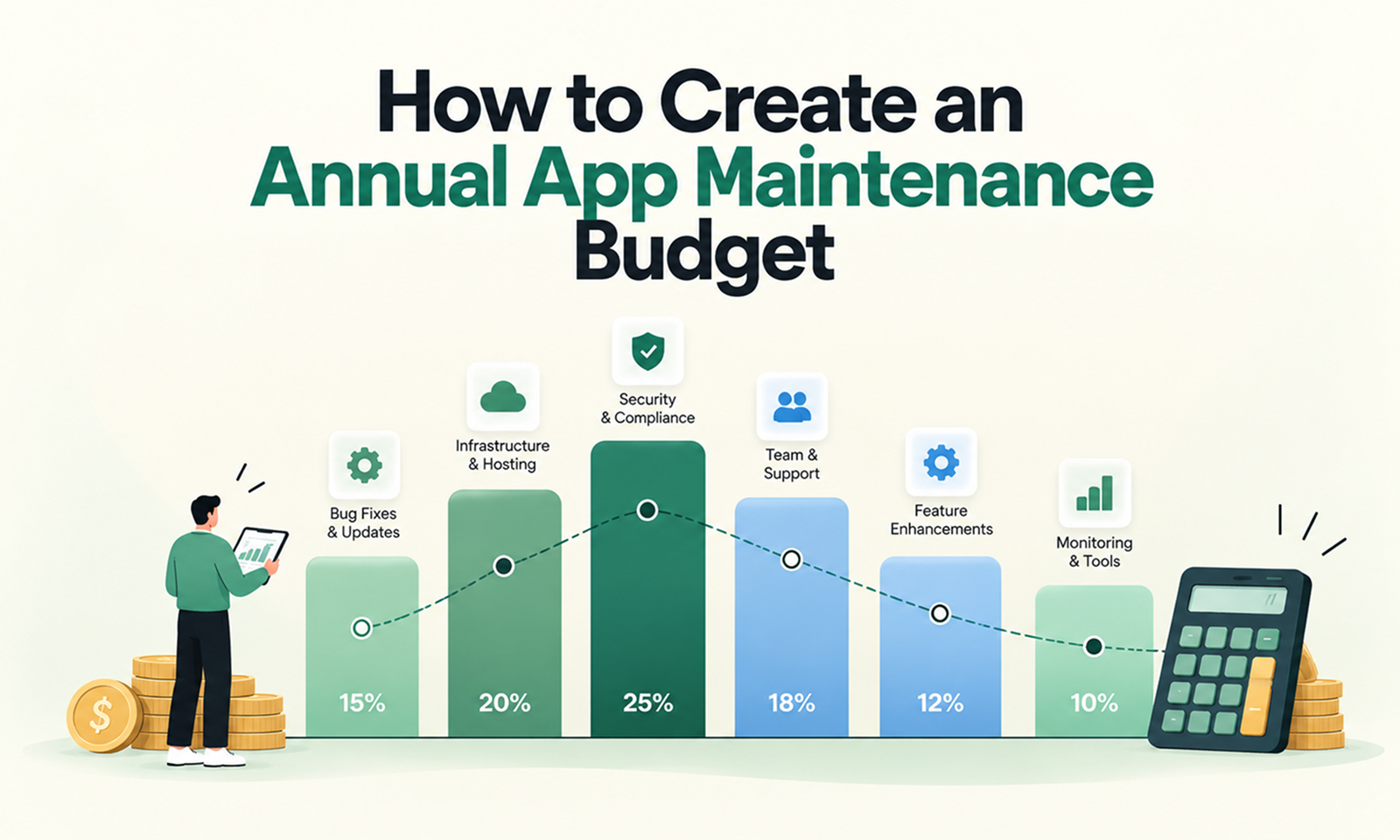
Annual maintenance budget = recurring maintenance capacity + known planned work + variable-work allowance + operating/tooling costs + approved improvement work
The exact amount will differ widely between applications. The method for building it should not.
The FinOps Foundation makes a useful distinction between forecasting and budgeting: forecasting models anticipated future technology spend using historical patterns and expected changes, while budgeting uses that forecast to allocate funding. FinOps Foundation: Forecasting
That distinction is equally useful for application maintenance. Do not choose the annual budget first and then try to fit maintenance into it. Build a realistic forecast of likely work, then decide what the organization will fund.
Before estimating money, define the boundary.
“Application maintenance” can easily become a catch-all for every cost associated with an application.
Decide whether the budget includes:
You may choose to keep cloud infrastructure and SaaS licensing in separate financial categories. That is perfectly reasonable.
What matters is consistency.
If last year's maintenance cost included AWS spend but this year's engineering forecast does not, a year-over-year comparison becomes misleading.
The maintenance scope should already establish which applications, environments and responsibilities the team owns.
[Internal Link: “How to Scope an Application Maintenance Engagement”]
Budget only after that boundary is understood.
For an existing application, historical evidence is the strongest starting point.
Review roughly the previous year of maintenance activity where useful data exists.
Look at engineering effort associated with:
Do not simply count tickets.
Fifty small configuration requests can require less engineering effort than three difficult production defects.
The useful measure is capacity consumed.
Depending on how the organization works, that might be represented as:
Then ask whether last year was representative.
A historical baseline should be adjusted when circumstances have changed. For example, last year's maintenance demand may underestimate the coming year if the customer base has doubled, an important framework is approaching end of support or several integrations are being added.
AWS's Well-Architected guidance recommends combining historical trends with business drivers when forecasting technology costs rather than assuming previous spending will repeat unchanged. AWS Well-Architected: Establish Cloud Budgets and Forecasts
The same principle works well for maintenance planning:
Start with what normally happens, then adjust for what you already know will change.
Not all maintenance demand behaves the same way.
Some work recurs continuously:
Other work is already predictable but happens once during the year:
Those should not be hidden inside the normal monthly run rate.
Suppose regular maintenance historically requires about two engineer-months each quarter, but the application also needs a substantial framework upgrade before support ends in Q3.
Budget those separately:
Recurring maintenance capacity
+
Known Q3 framework upgrade
+
Variable / incident allowance
+
Technology costs
This makes the budget explainable.
If the upgrade is postponed, the organization can see what funding or capacity changes rather than treating the difference as mysterious underspend.
Applications contain components with their own timelines.
Review the upcoming 12–18 months for known events involving:
OWASP's secure-dependency guidance recommends maintaining knowledge of component versions and proactively tracking updates and security issues rather than waiting until unsupported or vulnerable components create urgent work. OWASP: Use Secure Dependencies
For budgeting, this turns maintenance from an abstract allowance into a calendar.
Quarter
Known maintenance driver
Q1
Routine dependency updates
Q2
Payment SDK migration
Q3
Runtime/framework upgrade
Q4
Database version upgrade
Not every lifecycle event requires significant money.
The point is to discover the expensive ones before approving the budget.
Maintenance contains work that cannot be individually predicted one year in advance.
You will not know the title of every bug that will appear in September.
You can still forecast the approximate engineering capacity required to handle ordinary production demand.
For example, an engagement might require recurring access to:
That does not mean each role needs a full-time allocation.
A small application may need fractional capacity across several disciplines.
Translate expected workload into a capacity model.
An illustrative model might look like:
Capacity area
Expected use
Application engineering
Routine fixes and maintenance changes
QA/testing
Regression and release validation
DevOps/SRE
Deployment, monitoring and production operations
Specialist support
Security, database or UX when required
This is more useful than budgeting for an arbitrary number of tickets.
A “ticket” can represent ten minutes of work or two weeks of investigation.
One of the easiest budgeting mistakes is funding only visible demand.
Production bugs receive money because they already exist.
Support requests receive money because users are waiting.
Preventive work is easier to postpone because its value often appears as a problem that does not happen.
That creates a predictable pattern: the team spends its entire budget reacting to current problems while dependencies age, monitoring gaps remain and recurring operational work continues.
An annual maintenance budget should therefore include explicit capacity for work that reduces future risk or effort, such as:
Google SRE's work on operational toil is particularly relevant here. Google defines toil as repetitive, manual operational work that provides little enduring value and tends to scale with service growth. Its guidance recommends measuring that work and investing engineering effort in eliminating it where doing so produces a worthwhile return. Google SRE: Eliminating Toil
That investment needs budget.
If every maintenance dollar is assigned to today's operational workload, the team has no capacity to make tomorrow's workload smaller.
An annual budget that assumes nothing unexpected will happen is not realistic.
Applications develop:
You do not need to predict each event.
You need an approach for absorbing reasonable variability.
There are several ways to do that.
Keep part of maintenance capacity uncommitted to planned work.
Maintain an approved amount that can fund additional engineering when demand exceeds normal capacity.
Allow lower-priority planned maintenance to move when urgent production work consumes the team's capacity.
The right mechanism depends on the organization's commercial and staffing model.
Avoid choosing a universal contingency percentage simply because another company uses one.
Instead, use your own incident and defect history to estimate variability.
If maintenance demand has historically varied significantly month to month, a budget based only on the average month will be fragile.
Support expectations affect the annual budget substantially.
An application supported during business hours requires a different staffing model from one requiring rapid response around the clock.
Budget assumptions should therefore state:
Do not budget ordinary daytime engineering and simultaneously assume 24/7 production response is included somehow.
If an external maintenance provider is involved, commercial models may include retained capacity, support retainers, time-and-materials work, or combinations of these.
The annual budget should reflect the model actually required by the application's business criticality.
Detailed response commitments belong in an SLA; budgeting needs to make sure there is enough capacity to meet those commitments.
Even when technology operating costs are accounted for separately from engineering maintenance, include them in the annual application view.
Typical costs may include:
For variable infrastructure spend, do not simply multiply the latest month's bill by twelve.
Consider expected drivers such as:
AWS recommends using both historical cost trends and known business drivers when forecasting variable cloud spend, because usage and therefore cost can move as workloads scale. AWS Well-Architected: Establish Cloud Budgets and Forecasts
The FinOps Foundation similarly describes forecasting as combining historical spend, planned changes and application lifecycle information to estimate future technology cost. FinOps Foundation: Forecasting
Some spending does not maintain the current state; it improves how efficiently future maintenance can be performed.
Examples include:
These investments should be evaluated economically.
Suppose an engineer spends several hours every month performing the same deployment procedure manually. Automating that process may require a larger one-time investment but reduce recurring maintenance effort afterward.
DORA's research describes manual regression testing as time-consuming and expensive, while reliable automated testing provides faster feedback and reduces deployment pain. DORA: Test Automation
Its guidance on deployment automation similarly recommends reducing manual deployment steps because they increase both deployment time and opportunities for error.
Maintenance budgets should therefore distinguish between:
capacity required to perform recurring work
and
investment intended to reduce recurring work.
Otherwise, efficiency improvements continually lose to immediate tickets.
For applications with meaningful uncertainty, a single number can create false confidence.
A simple scenario model is more useful.
Expected maintenance demand assuming normal incident volume, known planned upgrades and forecast usage.
Higher support demand, more incidents, greater infrastructure growth or an unexpected vendor/platform migration.
A known business event such as entering another market, adding a major integration or significantly increasing application usage.
The scenarios do not need three separate approved budgets.
They show decision-makers what could cause the base budget to stop being sufficient.
This is especially useful when Finance asks:
“What would cause this number to change?”
The engineering team already has the answer.
Annual budgets are easier to manage when known spending is mapped to quarters or months.
For example:
Period
Expected emphasis
Q1
Baseline maintenance + security backlog
Q2
Normal maintenance + SDK migration
Q3
Framework upgrade + reduced discretionary work
Q4
Normal maintenance + database upgrade
This makes capacity conflicts visible early.
If Q3 already contains a major framework upgrade, scheduling a large infrastructure migration in the same quarter may require additional capacity or a deliberate trade-off.
Annual totals hide those collisions.
Time-phased plans expose them.
The budget is approved annually.
The forecast should not be frozen annually.
Record actual maintenance demand and update the forecast as information improves.
Useful monthly or quarterly measures include:
AWS recommends regular reviews between engineering, finance and other stakeholders and distinguishes a relatively fixed annual budget from a forecast that can be updated as circumstances change. AWS Well-Architected: Establish Cloud Budgets and Forecasts
That distinction is valuable.
Changing the forecast does not necessarily mean changing the approved budget. It means recognizing early that reality is moving away from the original assumptions.
A useful application-level budget can be summarized in six lines:
Budget component
Basis
Recurring engineering capacity
Historical maintenance demand adjusted for expected change
Known lifecycle work
Planned upgrades, migrations and required technical changes
Preventive improvement capacity
Work intended to reduce risk and recurring effort
Variable-work allowance
Historical incident/defect variability
Support coverage
Hours, on-call and specialist requirements
Infrastructure/tooling
Forecast usage, contracts and expected growth
Underneath each line should be the assumptions used to calculate it.
Those assumptions are more valuable than false precision.
[Internal Link: “What Factors Affect the Cost of Maintaining an Application?”]
When the initial forecast exceeds the available budget, something has to change.
Make the trade-off explicit.
Options might include:
What should not happen is quietly assuming the same service can be delivered with less capacity.
That simply moves the difference into delayed maintenance.
Levelworks' App Health framework can help here because budget decisions can be connected to technical consequences. Deferring work that protects Current & Updated, Tested, Observable, Secure or Well Documented App Health is sometimes reasonable, but the resulting risk should be visible rather than disappearing from the spreadsheet.
[Internal Link: “Preventive App Maintenance: How to Fix Problems Before Users Find Them”]
The purpose of annual budgeting is not to predict every ticket the application will generate during the next twelve months.
That would be impossible.
The useful work happens earlier: understand the application's normal maintenance demand, identify the lifecycle work already visible on the horizon, reserve engineering capacity for keeping the system healthy, and decide how much variability the organization is willing to absorb.
Then track what actually happens.
By the middle of the year, the organization should be able to explain why maintenance is above or below forecast, which planned work remains, and whether recurring operational demand is increasing or decreasing.
That is a far better position than reaching November with a depleted maintenance budget and discovering that an unavoidable framework upgrade, certificate migration or production reliability problem was never funded.
A good annual maintenance budget is therefore not a prediction of every future problem. It is a deliberate decision about how much capacity the business wants available when maintaining the application requires attention.