Three weeks before an annual compliance review, a product team opens the evidence from the previous year.
According to that documentation, customer exports are stored only in the application's primary environment. Support staff receive privileged access through an approved process, one external provider processes customer data, and a defined retention rule applies to uploaded files.
The application passed its previous assessment on that basis.
Then the team compares the documentation with production.
During the year, a new analytics provider was introduced. Support created an emergency-access process during a major incident. A mobile feature began caching files differently, while a new enterprise contract required longer retention for one category of information.
None of those changes was introduced as a compliance project.
Together, however, they mean the system described in last year's evidence is no longer the system running today.
That is the problem application compliance maintenance solves.
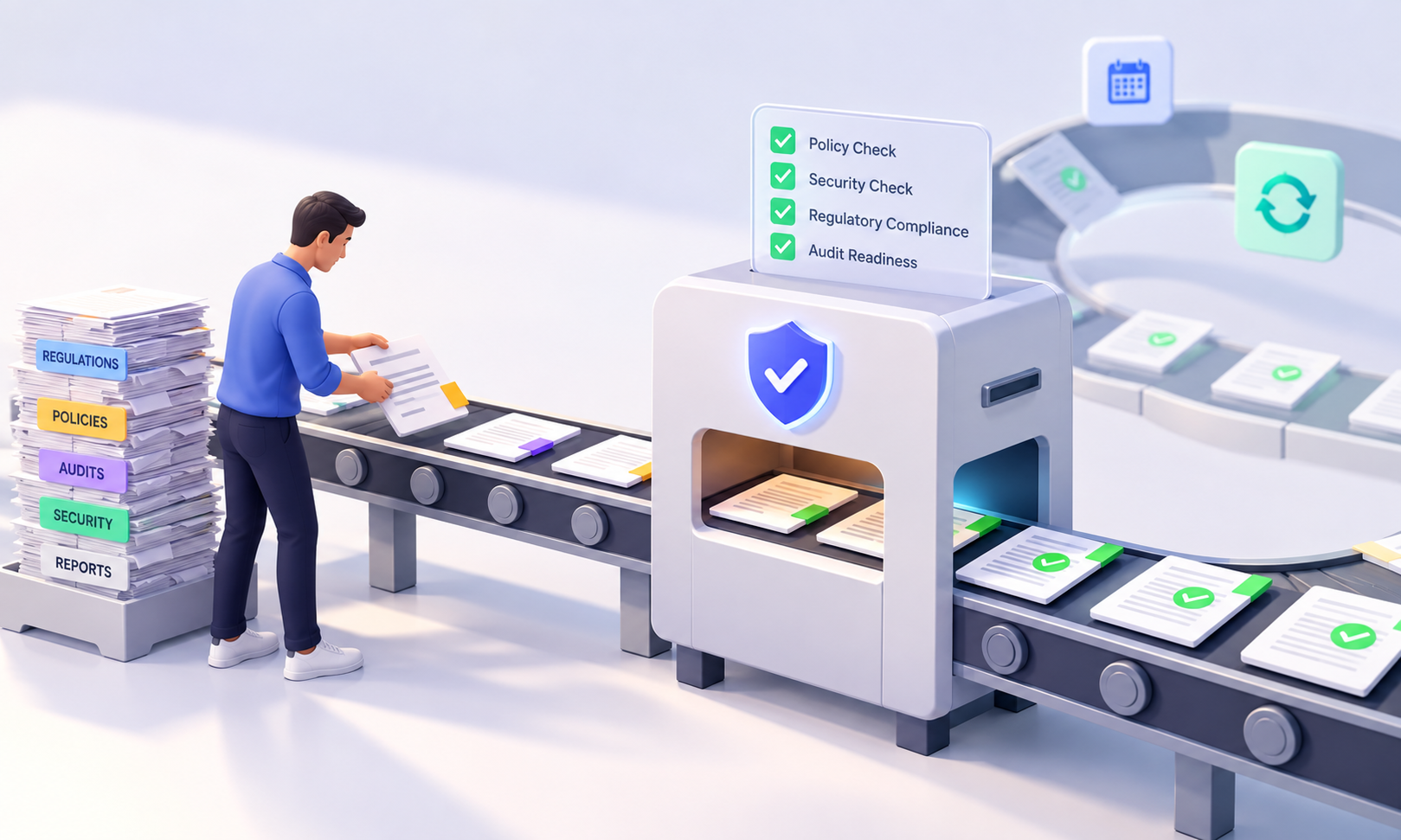
Compliance is not a status an application earns once. It is the continuing alignment between the application as it actually operates, the controls it claims to have, the evidence supporting those controls and the requirements that apply to it.
Regulatory frameworks themselves reflect this principle. Article 24 of the EU General Data Protection Regulation requires appropriate technical and organisational measures to be reviewed and updated where necessary. In the United States, HHS similarly states in its HIPAA guidance that compliance is an ongoing process rather than a one-time goal.
For Levelworks, this is the essence of the Compliant App Health dimension. A healthy application should not merely possess an old audit report; its current behaviour should continue to match the obligations and controls that apply to it.
Most compliance drift does not begin with somebody deliberately abandoning a requirement.
It develops through normal product work.
A feature collects another field. Engineering migrates infrastructure. The business enters a new market. Support receives additional access. An external service begins processing information. An API exposes a new category of data.
Each change may be reasonable.
The maintenance question is whether anyone reassessed the compliance assumptions affected by it.
Consider an application originally designed so sensitive customer data stays within one controlled environment. Later, a product feature sends some of that information to a third-party analytics provider.
The feature may work perfectly, but several compliance questions have changed:
The important principle is simple:
A product change can also be a compliance change, even when no policy document was intentionally modified.
One of the first things to become stale is scope.
Teams may continue testing old controls while overlooking the fact that new systems, data flows or vendors should now be covered by them.
A useful compliance inventory should remain able to answer:
PCI DSS offers a useful example of why this matters. The PCI Security Standards Council identifies changes to account-data flows, environment boundaries, underlying infrastructure and relevant third-party services as examples of changes that may be significant enough to require further compliance activity. PCI SSC: Significant Changes
The PCI requirements apply only where PCI DSS is relevant, but the underlying principle applies more broadly:
When the system boundary changes, reassess the controls attached to that boundary.
Otherwise an organisation can continue proving that yesterday's application was compliant while today's application has already moved beyond the original assessment.
A mature application should not wait until the next audit to discover that a feature altered its compliance posture.
Certain changes deserve review during design or delivery.
Application change
Compliance question
New customer data field
Why is it collected and what requirements apply?
New third-party provider
What data or system access will it receive?
New user role
Do existing access-control obligations still hold?
New geography
Do different legal or contractual requirements apply?
Infrastructure migration
Have data location or control ownership changed?
New API
Is regulated data available through a new route?
Retention change
Are deletion processes and commitments still aligned?
New logging
Are sensitive fields now appearing in operational data?
Not every application change requires a formal compliance assessment.
The aim is to identify changes that affect a relevant requirement, control, data flow or body of evidence.
That makes compliance part of change management instead of something reconstructed months later.
[Internal Link: “Security, Privacy and Compliance: The App Maintenance Checklist”]
Compliance programmes can accumulate impressive documentation while the software underneath them changes.
A control description may state:
Administrative access requires approval and multi-factor authentication.
That statement is useful only if the current application and operational process still behave that way.
Perhaps an emergency-access route was added after the document was written. Maybe one legacy service account can perform the same administrative operation through an API without going through the normal user authentication flow.
The documented control remains unchanged.
The real control has changed.
This is why compliance maintenance needs to compare policy with current implementation.
NIST's Information Security Continuous Monitoring guidance emphasizes maintaining awareness of system changes and determining whether controls continue to operate effectively over time.
The broader lesson is valuable beyond security-specific controls: evidence that a control existed two years ago does not prove that it is operating correctly today.
Compliance becomes unnecessarily expensive when teams collect evidence retrospectively.
A reviewer asks for proof that privileged access was reviewed during the year. Someone searches through old email approvals.
Engineering reconstructs deployment records.
Security gathers vulnerability-remediation tickets.
Operations tries to determine when a particular configuration changed.
A stronger model is to make useful evidence a by-product of normal work.
Depending on the requirement, that might include:
The objective is not unlimited documentation.
It is reliable evidence showing that required controls actually operated.
There is an important distinction here:
A control can function correctly and still be difficult to prove.
If teams repeatedly scramble to demonstrate that routine compliance activities happened, the process itself probably needs maintenance.
Applications rarely keep the same users and permissions throughout their lifetime.
Employees move roles. Contractors leave. Customers create administrators. Service accounts accumulate privileges, and temporary production access granted during an incident may remain longer than intended.
Many compliance frameworks care about access because access determines who can reach protected information or perform sensitive operations.
Maintenance should therefore revisit:
If a documented control says privileges follow least-privilege principles or require regular review, the live permission model has to continue supporting that claim.
A policy saying “access is periodically reviewed” provides little value if nobody can show when the review last happened or what changed because of it.
[Internal Link: “How to Maintain Authentication and Access Control in a Growing App”]
As products grow, the information they handle often changes.
A new feature may collect another customer attribute. A document-processing service creates an additional copy of uploaded information. Analytics receives data that previously stayed within the application.
Product teams naturally think about these decisions in terms of functionality.
Compliance requires another set of questions:
For organisations subject to GDPR, Article 24 reinforces the idea that controls should continue to reflect the nature, scope, context and purposes of processing rather than remaining tied indefinitely to an old system description.
A data-flow diagram created for an assessment has little ongoing value if nobody updates it when the application adds new processing paths.
Applications increasingly depend on external providers for hosting, authentication, payments, communications, analytics and support.
A provider being acceptable when originally selected does not make that relationship permanently settled.
Over time:
Compliance maintenance should therefore retain visibility into which providers participate in relevant application processes and who owns each relationship internally.
For example, HHS's HIPAA guidance requires appropriate written arrangements where business associates handle electronic protected health information on behalf of regulated organisations. HHS: HIPAA Security Rule
Not every application is subject to HIPAA, but the wider principle is useful:
Sending a function to a third party does not remove the need to understand the compliance implications of what that provider does.
Many application-maintenance activities support both.
A vulnerability left unresolved may create a security risk and a compliance issue. So may an unmanaged privileged account or insecure configuration.
But technically secure software can still have compliance problems.
For example:
Security asks whether the application is adequately protected.
Compliance asks a wider question:
Does the application continue to satisfy the obligations placed on it, and can the organisation demonstrate that?
That is why Levelworks treats Compliant as a distinct App Health dimension rather than another name for Secure.
[Internal Link: “Application Security Maintenance: What Needs to Happen After Launch?”]
Compliance drift does not always come from product changes.
The requirements around the application can also evolve.
Standards are updated. Regulatory guidance changes. Customer contracts introduce new controls. Industry expectations move.
PCI DSS again provides a useful example. PCI SSC released PCI DSS v4.0.1 in 2024 and subsequently retired version 4.0, requiring organisations working under the standard to align with the updated version rather than assuming the original requirements would remain static. PCI SSC: PCI DSS v4.0.1
Someone therefore needs responsibility for tracking changes in requirements that apply to the application and translating relevant updates into engineering, process or evidence changes.
Compliance maintenance works in both directions:
the application changes against the requirements, and the requirements can change around the application.
Assessments frequently identify gaps.
What matters is what happens next.
Suppose an audit finds that administrative access was not reviewed consistently. The team performs a review, removes several unnecessary accounts and marks the finding complete.
The immediate problem has been corrected.
But if nothing changes about the process, the same condition may return next quarter.
Effective remediation should distinguish between:
correcting today's instance
and
making the control sustainable.
Depending on the issue, the lasting correction might involve automation, scheduled reviews, better ownership, changed workflows or evidence generated automatically during normal operations.
Otherwise audits repeatedly identify the same weakness while the organisation repeatedly performs the same cleanup.
Some applications cannot meet every preferred control immediately.
A legacy component may not yet support a required authentication method. A migration may temporarily place information in two environments.
An exception can be legitimate.
An exception nobody remembers is dangerous.
For meaningful exceptions, record:
Without those boundaries, a temporary accommodation can quietly become permanent architecture.
If an organisation becomes compliant only during the weeks before an assessment, it is not maintaining compliance effectively.
Audit preparation should not be the moment teams first discover that old accounts still have access, architecture documentation no longer reflects production or new vendors were never added to the relevant inventory.
It should mainly involve collecting and validating evidence that already exists.
HHS makes this ongoing nature explicit in its HIPAA material, stating that compliance requires periodic evaluation in response to environmental or operational changes.
An audit is a checkpoint.
Compliance is what happens between checkpoints.
Different controls change at different speeds, so there is little value in forcing every compliance activity onto one calendar.
A practical approach combines recurring reviews with event-driven reassessment:
Activity
Trigger
Access review
Regular cadence and major role/personnel changes
Vendor review
Regular cadence and significant provider changes
Data-flow review
New features, integrations or data categories
Control review
Periodically and after meaningful system changes
Documentation update
When application behaviour changes
Finding remediation
Based on risk and agreed deadlines
Exception review
Before its defined review or expiry date
Broader assessment
Periodically and after substantial scope change
NIST's continuous-monitoring model similarly treats ongoing assessment as risk-based: controls should be examined often enough to support effective decisions rather than all being reviewed at identical intervals.
The important point is that there is always a mechanism for asking whether the existing compliance position still represents reality.
Compliance maintenance deserves attention when:
These conditions do not automatically prove violation of a particular regulation.
They indicate something more fundamental: the distance between documented compliance and operational reality is increasing.
A successful compliance assessment matters.
It provides evidence about a defined system and set of controls at a particular point in time.
Then the application changes.
So do customers, providers, employees, infrastructure, data flows and sometimes the requirements themselves.
Application compliance maintenance is the discipline of preventing those changes from creating an ever-widening gap between the application the organisation says it operates and the one actually running in production.
For Levelworks, that is what Compliant App Health means in practice: not permanent paperwork, but continued alignment between requirements, controls, application behaviour and evidence.
The best sign that compliance is being maintained properly is not a frantic month before the next assessment.
It is arriving at that assessment and finding very few surprises.