A startup maintenance backlog can contain five completely legitimate pieces of work at the same time.
A recurring checkout failure needs investigation. Several dependencies are behind on updates. Automated test coverage is thin. The deployment process still contains manual steps. Engineers also want to refactor a module that becomes frustrating every time they touch it.
There may be enough engineering time to address two of them.
That is the real application-maintenance problem for startups: not deciding whether maintenance matters, but deciding which maintenance deserves scarce money and engineering attention now.
A startup cannot usually maintain every part of its application to the same standard as a mature company with dedicated security, platform, QA and reliability teams. Nor should it try. Applying enterprise-scale process indiscriminately can consume resources without materially reducing the risks that matter most to the business.
The better approach is selective.
Protect failures that could seriously harm the company. Keep the core customer journey dependable. Prevent important technical risks from compounding. Automate recurring work when the economics justify it. Defer improvements whose cost exceeds the risk they currently remove.
For Levelworks, that means thinking about App Health as a prioritization tool rather than a demand to perfect all 17 aspects simultaneously.
When maintenance capacity is limited, severity should come before neatness.
Ask what would happen if a known weakness actually failed.
Some problems can create consequences disproportionate to the size of the engineering task:
Those risks deserve attention before cosmetic defects, architectural elegance or low-impact optimization.
This leads to a useful first maintenance category:
Identify the small number of workflows the business cannot reasonably operate without.
For a SaaS startup, that might be:
Sign up → Activate → Use core feature → Pay → Renew
For a marketplace:
Find → Purchase → Pay → Fulfil
For another product, the sequence will be different.
Maintenance should protect those workflows disproportionately.
A startup with limited resources gets more value from reliably detecting failures in its three critical customer journeys than from building beautiful dashboards for forty low-impact services.
Security cannot be postponed simply because the team is small.
But “fix everything security-related immediately” is not much of a prioritization strategy either.
Concentrate first on vulnerabilities with realistic exposure and serious consequences, especially around:
The current OWASP Top 10:2025 places broken access control, security misconfiguration and software supply-chain failures among the major risks facing web applications. OWASP's software supply-chain guidance also specifically includes dependencies on vulnerable, obsolete or unmaintained third-party components.
The startup lesson is not to perform a complete security transformation before shipping another feature.
It is to avoid carrying security risks whose downside could threaten the company.
A minor vulnerability in an inaccessible internal utility and an authorization flaw exposing customer data should not compete equally for the same engineer.
[Internal Link: “How to Prioritize Bugs, User Issues and Feature Requests”]
Backups rarely feel urgent until they are needed.
That makes them particularly vulnerable to startup prioritization.
At minimum, know:
Then test a restoration.
A dashboard showing a successful backup job is evidence that a backup ran, not that the company can recover from it.
NIST describes contingency planning as the combination of procedures and technical measures needed to recover systems, operations and data following disruption. Recovery planning includes restoring information systems and maintaining procedures capable of returning critical operations. NIST: Contingency Planning
A startup does not necessarily need an elaborate disaster-recovery program.
It does need confidence that losing one production database will not become an existential event.
Early-stage teams sometimes postpone monitoring because they see observability as infrastructure for larger companies.
The mistake is thinking monitoring means collecting every possible metric.
A startup needs a much narrower first objective:
Know quickly when customers can no longer do the thing they pay you for.
Monitor the critical path.
That may include:
Avoid creating alerts for everything.
A small team receiving constant low-value notifications will simply learn to ignore them.
For Levelworks, this is Observable App Health at startup scale. The goal is not perfect observability. It is enough visibility to prevent customers from repeatedly becoming your monitoring system.
When engineering capacity is scarce, recurrence matters.
Suppose one bug affects a customer once and requires thirty minutes to resolve.
Another causes three support requests every week, repeatedly interrupts an engineer and requires the same manual workaround each time.
The second problem may deserve priority even if each individual occurrence looks less severe.
Google SRE describes repetitive, predictable operational work as toil and recommends measuring it because this kind of work can expand until it consumes a team's capacity. Google SRE: Eliminating Toil
For startups, recurring problems are especially expensive because the same engineers often need to build new product capabilities as well.
Every repeated intervention steals time twice: once when the problem happens and again when somebody has to regain context on planned work.
Before adding another maintenance ticket to the backlog, therefore ask:
Is this something we have already paid engineering time to deal with before?
If yes, eliminating the cause can have unusually high leverage.
A startup does not need to install every package update on the day it is published.
It also should not allow important frameworks and dependencies to drift several major versions behind without understanding the consequences.
Prioritize updates when:
Avoid turning dependency maintenance into an endless pursuit of the newest possible version.
The objective is supportability, not novelty.
Regular smaller updates can also prevent the startup from reaching a point where an urgent security patch requires a major framework migration first.
That is the startup interpretation of Current & Updated App Health: keep enough of the technology current that routine maintenance remains routine.
A startup with limited engineering capacity probably cannot immediately build comprehensive automated regression coverage.
It should not use that as a reason to build none.
Start around the highest-value workflows.
If losing checkout would immediately affect revenue, automate checkout.
If account creation is the product's acquisition bottleneck, protect registration and activation.
If one data-processing workflow represents the application's core value, test that workflow.
DORA's research on test automation notes that manual regression testing is expensive and creates slower feedback, while reliable automated testing provides earlier information about whether a change broke existing behavior. DORA also explicitly recommends incremental improvement for brownfield systems rather than stopping everything to retrofit a comprehensive test suite at once.
That is particularly appropriate for startups.
Do not set “90% code coverage” as an arbitrary maintenance objective.
Ask:
Which failure would be expensive enough that we want software checking it every time we release?
Build outward from there.
A startup does not need the deployment infrastructure of Netflix.
It does need a release process the team understands and can repeat without relying on somebody remembering seventeen manual steps.
A useful early goal is straightforward:
Code
↓
Review
↓
Automated checks
↓
Repeatable deployment
↓
Basic production validation
DORA's deployment automation guidance recommends reducing manual deployment steps because each additional step creates both delay and another opportunity for error.
If releases are already straightforward and low risk, do not spend months building an elaborate platform.
If every production release requires the founder to message the only engineer who knows which server command to run, maintenance investment is justified.
Good startup maintenance is often about removing dangerous dependency on individuals without creating unnecessary process.
Automation sounds efficient, but automation itself costs engineering time.
Do not automate every process simply because it is manual.
A good startup candidate for automation is work that is:
If an engineer spends hours every week manually repairing the same failed import, automating detection or recovery may pay back quickly.
If a task occurs once every eighteen months and takes ten minutes, automating it may be economically pointless.
Google SRE makes a similar distinction around toil: repetitive, automatable operational work becomes problematic when it grows and consumes engineering capacity.
AWS's cost-optimization guidance likewise recommends examining time-consuming operational activities and automating them where doing so reduces human effort and cost. AWS Well-Architected: Optimize Over Time
The startup rule is simple:
Automate the expensive repetition first.
Documentation is another area where startups can easily overcorrect.
You do not need fifty pages explaining every class.
Start with knowledge that would create an operational problem if one person disappeared tomorrow.
That normally includes:
Documentation should concentrate on reducing key-person dependency.
A beautifully documented low-impact module is less valuable than one current page explaining how to recover the production database.
For Levelworks, that is Well Documented App Health applied proportionately.
Startups frequently worry about whether their architecture will support ten times or one hundred times current traffic.
Sometimes that concern is legitimate.
Often it is premature.
If current usage is nowhere near meaningful limits and growth is observable, maintain enough monitoring to identify when capacity assumptions start becoming false.
Then act based on evidence.
AWS's Well-Architected cost guidance explicitly recognizes the trade-off between optimization, cost and speed to market rather than assuming every architecture should be maximally optimized from the beginning. AWS Well-Architected: Cost Optimization
A startup does not need infrastructure capable of supporting a million customers when it has five thousand.
It does need enough capacity visibility to avoid discovering the limit through an outage.
Limited maintenance budgets require deliberate deferral.
Unless there is a specific risk or business requirement, lower-priority work may include:
“Defer” does not mean “ignore forever.”
Record why the work was deferred and what would cause it to move up the priority list.
For example:
Rework reporting architecture when query latency exceeds the agreed threshold or enterprise reporting becomes a product priority.
That turns technical debt into a conscious decision rather than forgotten maintenance.
When two maintenance items compete, ask:
Look at customer, security, revenue, data and operational consequences.
An extreme failure with almost no realistic path may rank below a moderate issue happening every week.
Framework lifecycle work often fits here.
Doing nothing today can increase tomorrow's upgrade cost.
Removing repeated operational effort can release future engineering capacity.
The best maintenance priorities often score strongly across several of these questions.
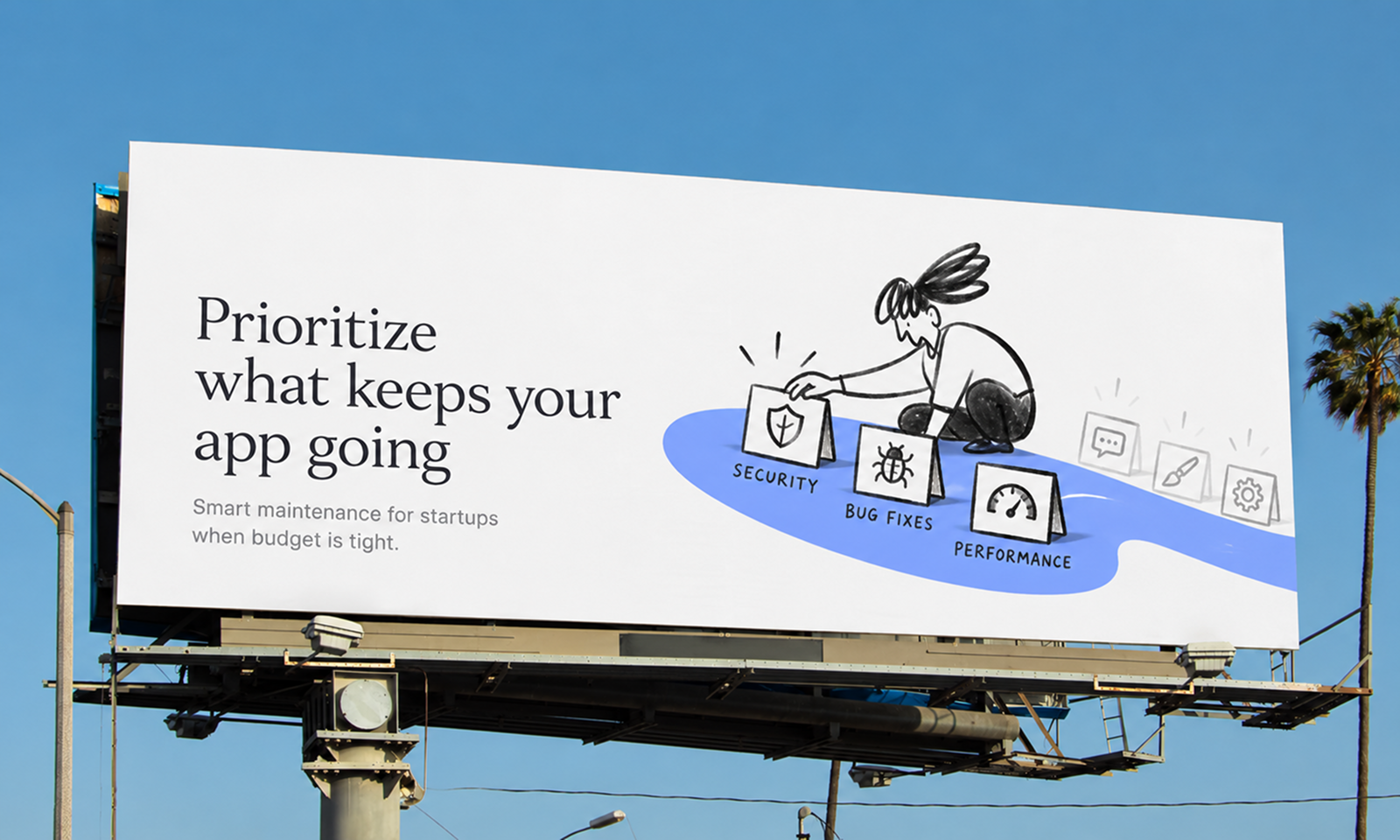
A practical way to organize the backlog is:
Priority
What belongs here
Protect now
Serious security exposure, data-loss risk, core-journey failures, unrecoverable systems
Keep healthy
Critical monitoring, supported dependencies, core automated tests, safe releases
Reduce recurring cost
Repeated incidents, manual interventions, noisy operational work
Prepare deliberately
Known upcoming lifecycle or capacity constraints
Defer consciously
Cosmetic improvements, speculative scale, low-value refactors
This is not a universal ordering for every startup.
A healthcare startup and a social productivity app have very different consequences of failure.
The point is to force maintenance spending to follow risk and business value rather than developer irritation or whichever ticket arrived last.
[Internal Link: “Preventive App Maintenance: How to Fix Problems Before Users Find Them”]
Another common startup mistake is making maintenance compete with feature development every week.
Features have visible business sponsors.
Preventive maintenance usually does not.
If maintenance capacity is simply “whatever remains after product work,” the answer will frequently be nothing.
That does not mean dedicating half the engineering organization to maintenance.
Set an explicit amount of capacity or budget appropriate to the application's condition and revisit it periodically.
Track where that capacity actually goes:
If almost all of it is continually consumed by incidents, that itself is useful information. The application may need deeper corrective work rather than a larger break/fix allowance.
[Internal Link: “How to Create an Annual App Maintenance Budget”]
A startup should not attempt to maximize every Levelworks App Health aspect equally.
Instead, App Health can help reveal where limited maintenance money changes risk most.
An early-stage application may discover that it is already sufficiently Performant and Scalable for current demand, while being dangerously weak in Observable, Tested and Well Documented.
That suggests where to invest.
Another startup may have good engineering fundamentals but depend on unsupported technology, making Current & Updated and Secure the immediate concern.
The point of assessing application health is not to create seventeen parallel improvement programs.
It is to distinguish:
healthy enough for now
from:
this weakness is creating meaningful business risk.
That is also where a focused maintenance partner such as Levelworks can be useful for startups that cannot justify building every engineering specialty internally: diagnose the important gaps, provide capability where needed, and concentrate maintenance effort on the parts of the application where improvement changes the risk or cost profile.
Startups cannot afford to maintain software perfectly.
They also cannot afford to repeatedly pay for the same preventable failures.
The best limited maintenance budget is therefore not the one that funds the longest backlog. It is the one that protects the company's critical paths and steadily removes the problems most likely to consume future engineering attention.
Secure the dangerous areas. Protect the data. Watch the customer journeys that matter. Keep core technology supportable. Test the functionality the business depends on. Make releases repeatable. Eliminate recurring manual work when doing so has a clear payback.
Everything else can compete for what remains.
That is not cutting corners indiscriminately. It is recognizing that, for a startup, good application maintenance is fundamentally an exercise in deciding which corners cannot safely be cut.