
Procurement planning and optimization

Modernizing procurement execution for a multi plant automotive manufacturer.

Dana Anand Group manufactures drivetrain and powertrain components for global OEMs, operating a high volume network of seven plants in India.

In a complex, high volume automotive manufacturing environment, we partnered with Dana Anand Group to strengthen procurement execution across seven plants in India. The work sat at the intersection of SAP driven manufacturing plans and day to day procurement and logistics decisions made by engineers, plant teams, and leadership.

The engagement focused on modernizing the procurement execution system into a high performance, workflow led platform that connected planning to execution, improved usability for operational teams, and enabled scalable decision making without disrupting SAP.
Committed to developing and upholding sustainable practices
We believe that the built environment plays an important role in achieving these goals
Committed to developing and upholding sustainable practices

Dana Anand's Customers Includes

Images in this case study are AI-generated and used for illustration purposes only
Problem
Procurement and plant teams managing high volume execution across seven plants, facing long procurement cycles, limited cross plant inventory visibility, and increasing over procurement. To augment their SAP they had a custom .NET system which became too slow and unreliable for day to day decision making and teams increasingly relied on spreadsheets to keep operations moving.
How might we?
1
Align procurement execution with SAP production plans across seven plants
2
Enable production plan–driven procurement execution (production planning)
3
Improve system performance from minutes to milliseconds for daily decision making
4
Enable cross plant inventory visibility to reduce redundant procurement
5
Improve vendor performance management and reduce dependency risk across suppliers
6
Build a modern interface that teams adopt without spreadsheet workarounds

Align procurement execution with SAP production plans across seven plants

Dana Anand Group used SAP as the system of record for manufacturing plans, while procurement execution was managed through a custom in house .NET based ERP extension. The procurement execution system needed to consume SAP manufacturing data, translate it into actionable procurement and logistics workflows, and support decision points used by Production Planning Engineers, Plant and Shop Floor Managers, and Procurement and Operations leadership across multiple plants.

We redesigned the workflow to start from production items and derive the required raw materials automatically, so procurement execution followed production intent rather than ad hoc ordering. To support this reliably across seven plants without changing SAP, the platform ingested SAP exported CSV files through scheduled background jobs and ran a preprocessing layer to clean, normalize, and enrich the data into decision-ready structures such as production demand, material requirements, and plant-level supply positions

This shifted procurement execution toward a workflow first design that reflected operational reality across plants. It reduced cognitive load on plant and floor managers, made decision logic more consistent, and enabled informed, fast, and repeatable decision making, while continuing to coexist with SAP without invasive changes to the ERP landscape.

Images in this case study are AI-generated and used for illustration purposes only

Enable production plan–driven procurement execution

Procurement cycles ranged from 1.5 months to as high as 4 months for certain materials, while production schedules continued to evolve dynamically. To protect production continuity and avoid line stoppages, teams routinely placed excess procurement orders as a safety buffer. Over time, this behavior led to chronic over procurement and capital locked in unused stock, including approximately USD 2 million worth of lubricants in inventory.

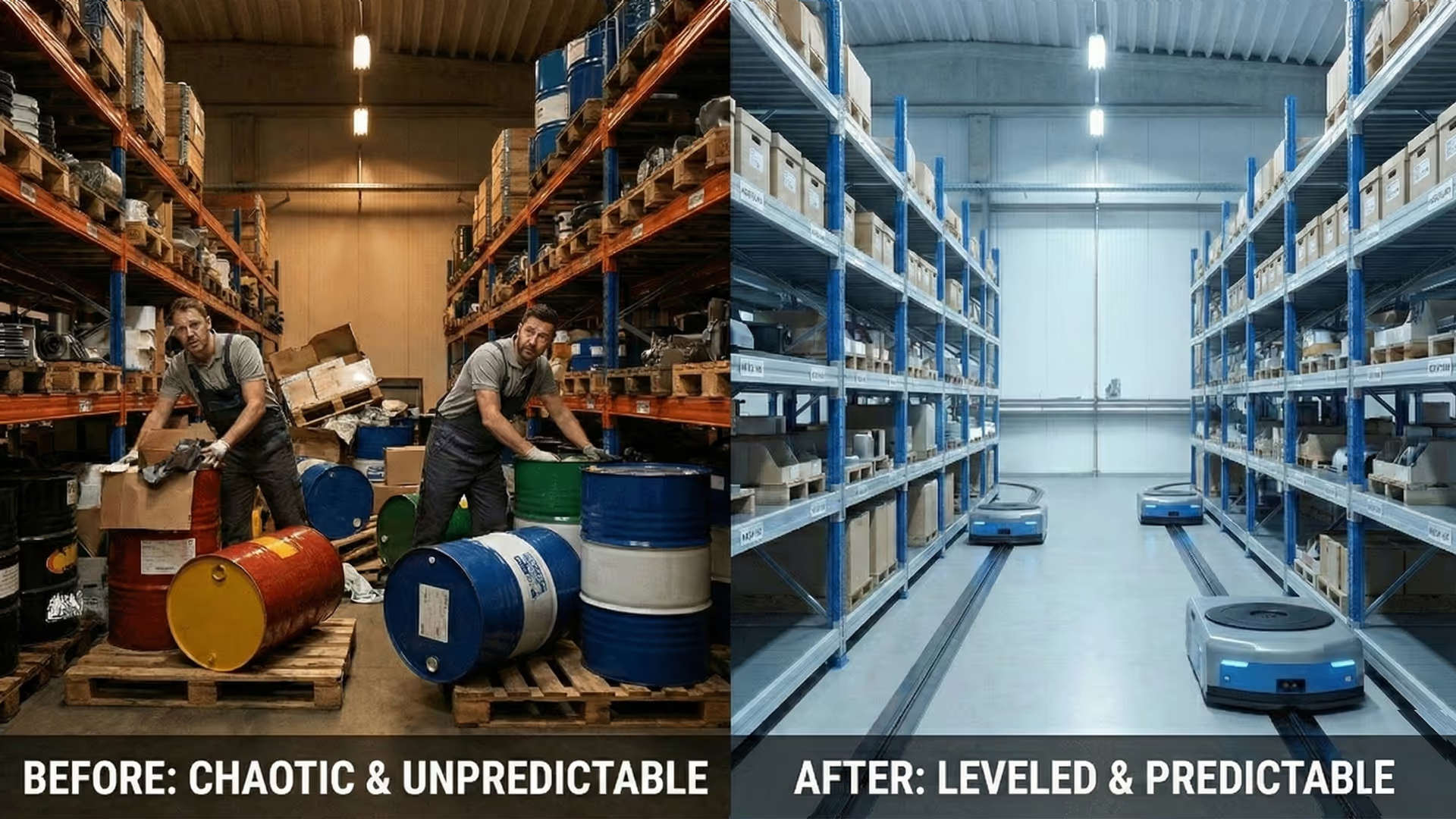
We introduced plan-driven procurement discipline by making ordering decisions explicitly track production planning changes rather than relying on buffer behavior and tribal judgement. The execution workflow supported steadier, more predictable ordering through production-driven demand signals, clearer planning gates, and leveling logic inspired by Heijunka principles to reduce spikes and waste. This was reinforced with vendor reliability inputs and supply distribution controls so teams could commit to procurement decisions with higher confidence and less overbuying.

This reduced over procurement and improved inventory holding costs by lowering redundant and overlapping orders. It also improved material flow stability across plants and reduced capital locked in unused inventory, including the elimination of the previously observed USD 2 million lubricant overstock.

Images in this case study are AI-generated and used for illustration purposes only

Improve system performance from minutes to milliseconds for daily decision making

The existing .NET application exhibited severe performance degradation, with page load times reaching up to 300 seconds. Slow response times made the system impractical for Production Planning Engineers, Plant and Shop Floor Managers, and Procurement and Operations leadership, and as a result users reverted to manual workarounds. Performance and adoption issues were systemic, driven by architectural choices rather than isolated implementation defects.

We re-architected the monolithic ASP.NET MVC application into an API first, resource oriented backend and separated interactive decision screens from heavy processing. Expensive transformations were shifted into preprocessing of SAP exported CSV data, while frequently used queries were optimized using explicit projections and caching to avoid repeated computation at runtime. Observability was introduced through structured logging, monitoring, and tracing to identify bottlenecks early and make performance improvements measurable and repeatable.

This delivered a step change in performance, improving page and API response times from about 300 seconds to 168 milliseconds. Response times were further optimized by caching which resulted in a performance improvement of about 1,800 times. Near instant access to procurement and inventory data reduced timeouts and retries, eliminated spreadsheet based workarounds, and made the system reliable for operational decision making.

Images in this case study are AI-generated and used for illustration purposes only
Exclusive | DRDO's High Altitude Navigation System (HANS) | IDAX 2024
Transforming Alternative Education | Lateshia Woodley | TEDxDecatur
Val-Ed founder Mayank Solanki sharing few thoughts on character building.

Enable cross plant inventory visibility to reduce redundant procurement

Inventory visibility was limited to individual plants, which made it difficult to see what material was already available elsewhere in the network. This contributed to redundant and overlapping orders and increased capital locked in unused stock, even as new procurement orders continued to be generated.

We enabled cross-plant inventory visibility by modeling materials, inventory positions, plants, and movement constraints as a connected system rather than isolated plant snapshots. This was supported through graph based relationships so teams could discover what stock existed elsewhere, identify usable substitutes, and understand transfer feasibility as part of the execution flow.

This improved cross plant material utilization and reduced redundant procurement. It helped reduce excess inventory and improved working capital efficiency by enabling inventory to be moved between plants instead of being re ordered.

Images in this case study are AI-generated and used for illustration purposes only

Improve vendor performance management and reduce dependency risk across suppliers

Vendor and supplier coordination was a critical part of procurement execution, with multiple vendors, materials, routes, and delivery cycles that needed to be managed efficiently. As scale increased, teams needed clearer visibility into vendor reliability and a structured way to avoid over depending on any single supplier for critical materials.

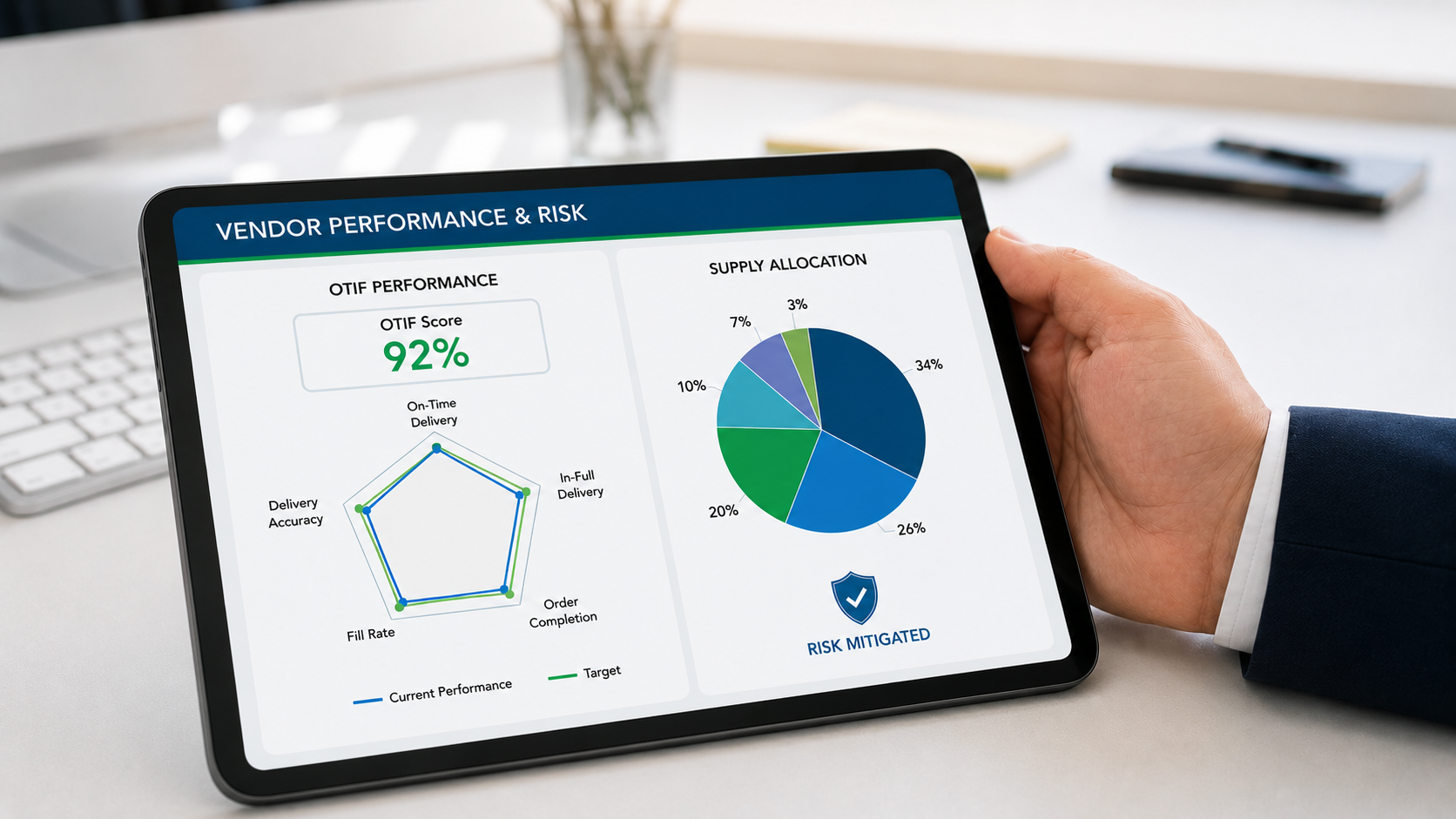
We built vendor governance into daily procurement execution by tying supplier selection to measurable reliability and enforceable allocation rules. Vendors were tracked using OTIF scoring, and procurement decisions incorporated controlled vendor supply percentage constraints so critical categories were not silently concentrated with a single supplier.

This enabled stronger vendor performance management and more reliable supply decisions across plants. It improved procurement predictability and distributed risk across suppliers while keeping vendor selection and allocations consistent and repeatable within the system.

Images in this case study are AI-generated and used for illustration purposes only

Build a modern interface that teams adopt without spreadsheet workarounds

Plant and shop floor teams needed a system that guided them through real execution workflows, not one that forced them to interpret complex data structures on their own. In practice, users needed to move from production intent to material requirements and vendor options with clarity, and they needed screens that supported fast decisions across plants, vendors, and inventory, without adding cognitive load.

We redesigned the user experience as an Angular Single Page Application focused on workflow visualization and usability, built as a clean presentation layer rather than a logic-heavy client. Business rules and decision consistency were centralized behind an API first, resource oriented backend with explicit data contracts, so the UI could remain responsive, role-friendly, and easy to evolve without duplicating logic across screens.

This UI and logic separation made it easier to evolve screens and workflows iteratively while keeping decision logic consistent. It improved usability for engineers, plant managers, and leadership and supported increased reliance on the system for daily procurement decisions, reducing the need for spreadsheet based workarounds.

Images in this case study are AI-generated and used for illustration purposes only

Teams reported faster procurement decisions, better inventory visibility across plants, and a system they could rely on daily.

Stakeholders included Production Planning Engineers, Plant and Shop Floor Managers, procurement and operations leadership, and IT and security teams, working across procurement, inventory, vendor coordination, and multi plant execution.
1,800×
Performance improvement
~3s
Page response time, down from ~300 seconds
* Images in this case study are AI-generated and used for illustration purposes only
Educator
Admin
Management
Content
Operational
Procurement Predictability
By aligning procurement execution directly to SAP-driven production intent, the platform shifted ordering from buffer-based decisions to planned, repeatable execution. Instead of relying on tribal judgement and safety overbuying, teams could derive material demand from production items, validate readiness, and commit to procurement actions with clearer structure and confidence.

This improved stability in material flow across plants and reduced the overlapping, redundant orders that typically build up when planning changes outpace execution. As procurement became more predictable, teams were able to reduce excess purchasing and lower inventory holding costs, including the elimination of approximately USD 2 million in lubricant overstock.
Operational Speed
The legacy procurement execution system had become too slow to support daily decision making, with page load times reaching up to 300 seconds. This friction pushed teams toward spreadsheet workarounds and slowed coordination between production planning, procurement, and leadership—especially when decisions needed to be made quickly across plants.

By re-architecting the system to return decision-ready outputs with performance optimized services, the platform enabled near real-time access to procurement and inventory data. Page and API response times improved from about 300 seconds to 168 milliseconds, with caching reducing key queries to approximately 3 milliseconds. This restored usability, reduced retries and timeouts, and made the system reliable for operational execution.
Inventory Efficiency
Inventory visibility was previously limited to individual plants, making it difficult to know what stock already existed elsewhere in the network. As a result, materials were often re-ordered even when excess inventory was available in another plant, increasing working capital locked in unused stock and driving avoidable procurement activity.

With cross-plant visibility built into the execution workflow, teams gained a shared view of material availability across the plant network and could reuse inventory before raising new purchase orders. This improved cross-plant material utilization, reduced redundant procurement, and strengthened working capital efficiency by enabling stock to be moved and consumed across plants instead of being repeatedly re-ordered.
Client Experience
“The team worked closely with our scientists and engineers to understand real operational constraints. Their deep involvement helped deliver a secure, offline navigation and communication system that meaningfully improved field readiness and safety in high altitude & other inaccessable environments.”
DRDO
Lead Scientist
DRDO

More Case Studies